


The reason you crash at 3 PM has almost nothing to do with what you ate for lunch.
You’ve been told it does. The heavy meal, the carbs, the sugar dip.
So, you eat lighter. You swap the bistro burger for a salad. And the wall still shows up at the same time it always does.
Right around 3 PM. The cursor blinks. You read the same sentence four times and it won’t go in.
You reach for coffee you don’t want, or something sweet you’ll regret. And underneath it runs the quiet voice that says the same thing every day.
“Why can’t I just push through?”
Here’s what we want you to sit with, because it changes everything that comes after.
That crash is not a discipline problem. And it’s not really your lunch either. It’s a budgeting problem, and you’ve been handed the wrong tools to solve it for years.
• • •
You’ve been managing time. The problem was always energy.
Look at what you reach for when you feel behind. A planner. Time blocks. A new app. A tighter calendar.
Every one of those tools manages the same resource: time. And time is the one thing in your day that is genuinely fixed. Everybody gets 24 hours.
But you already know that two hours are not the same as “two hours.”
Two hours first thing, coffee in hand, brain clear. That’s a different currency than two hours mid-afternoon with a full inbox and three people needing you.
Same amount of time. Completely different amount of you.
That difference has a name, and the name is energy.
Energy is the resource you’re spending all day. And unlike time, energy is not fixed.
It has a budget. Income and expenses. It can be spent well, spent badly, saved, protected, or quietly drained by leaks you never see on the statement.
When you try to fix an energy problem with a time tool, you get exactly what you’ve been getting. A more organized calendar, sitting on top of a body that’s still bankrupt by mid-afternoon.
• • •
The proof: the crash is a rhythm, not a reaction
The afternoon dip, which researchers call the post-lunch dip, is not caused by your lunch. We know this because it shows up even when there is no lunch.
In controlled studies where people were given only small hourly liquid feedings and no actual meal, the afternoon drop in alertness and performance appeared anyway, right on schedule.
Chronobiologist Timothy Monk, reviewing this work, describes the dip as a genuine biological rhythm. A dip that is largely independent of what, or whether, you eat.
Read that again, because it quietly takes the guilt off the table.
You’re not crashing because you lack willpower. You’re not crashing because you ate wrong.
You’re crashing because your body runs on internal rhythms that rise and fall across the day whether you approve of them or not. The afternoon is simply a scheduled low point in the cycle.
And if the crash is a rhythm, then the fix is never “try harder.”
You cannot out-discipline a tide. You can only learn when it comes in, and stop spending like it won’t.
• • •
What the hardest part of ballet class teaches about your day
There’s a section of every ballet class called adagio. Slow, sustained movement. A leg lifted and held. A balance carried through long, unhurried counts.
To anyone watching, it looks like the easy part. Nothing fast is happening. No leaps, no spins. Just a dancer, seemingly still as seen in this YouTube video by Dansique Fitness (2018).
Ask any dancer and she’ll tell you: adagio is the most exhausting thing in the room. Holding a position steady burns more than moving through it. The stillness is the work.
The parts of your day that look like nothing are the parts spending the most.
That’s your day.
The visible work, the meetings, the deliverables, the things with your name on them, none of that is what empties you.
What empties you is the adagio. The holding steady. Staying pleasant in the hard conversation. Keeping it together when it’s falling apart. Carrying the thing nobody sees you carrying.
It looks like nothing. It costs the most. And because it never shows up on any to-do list, you never budget for it, so it runs your account down before the real work even starts.
The Energy Budget: three lines on the statement
So, we stop managing time and start managing the energy budget.
And every budget, the money kind and this kind, has exactly three moving parts. Once you can see all three, your whole day reorganizes around them.
Fixed costs. The non-negotiable daily drains. The adagio holds you can’t delete, only plan around. Your “rent.” They come out first, every day.
Renewables. The things that genuinely put energy back. Not the fake kind that only feels like rest. And most women spend theirs on the wrong things without realizing the account never refilled.
Leaks. The hidden withdrawals. Small, constant, invisible drains that never appear on your statement but empty the account faster than any big task. There are five that hit our readers hardest.
Naming the three shows you where your energy goes. But naming a leak and stopping it are two different things, and the second one is where the actual system lives.
Below the line, we hand you the full Energy Budget:
all three categories worked,
the five specific leaks most women never count and how to seal each one,
the recovery science on what actually renews, and
a weekly template that shows you where your energy goes before 3 PM ever arrives.
Nothing here asks you to find more hours. It asks you to spend the energy you already have on purpose.
Line one: Fixed costs
Fixed costs are the drains that leave your account every day whether you plan for them or not. The commute. The standing meetings. The pickup. The people who need a piece of you before 10 AM.
And the biggest one, the one that never makes the list, is the adagio holds: staying composed, managing everyone’s temperature, being the steady one.
The move: budget them first, and stop pretending they’re free.
A budget starts by writing the rent down. So, name your real fixed costs, including the invisible emotional ones, and accept that the energy they take is already spent.
What’s left after that is your actual working balance. Not the 12 hours on the clock. The far smaller amount of you that’s left once rent is paid.
Plan your hardest work around that real balance, and you stop scheduling your most demanding task into a moment when there’s nothing in the account to fund it. Which is exactly what you’ve been doing at 3 PM.
• • •
Line two: Renewables
Renewables put energy back in. And this is where the money leaks fastest, because most of what we call “rest” doesn’t renew anything.
Recovery researchers Sabine Sonnentag and Charlotte Fritz found that what makes rest restorative isn’t how relaxing it looks. It’s whether it delivers real psychological detachment: being genuinely mentally off, not just physically stopped.
Scrolling stops your body, not your mind. That’s why you can “rest” for an hour and stand up feeling no richer than when you sat down.
And a second piece that reframes rest entirely. Atsunori Ariga and Alejandro Lleras showed the afternoon fade isn’t your attention running out. It’s your brain habituating to a goal it’s held too long, the way you stop hearing a sound that never changes.
Their finding: brief, deliberate breaks that fully step away, then return, keep performance from decaying. Not because you refueled, but because you reset the goal.
Real recovery isn’t stopping. It’s stepping fully off, then stepping back on.
The move: spend renewables before the trough, not after the crash.
The instinct is to wait until you hit the wall, then collapse. By then you’re spending from an overdrawn account.
Instead, pre-spend. A genuine, detached break in the late morning, and again just before the early-afternoon low. A real walk, eyes off the screen. A few minutes fully away.
You’re not resting because you’re empty. You’re depositing before the withdrawal hits, so 3 PM lands on a cushion instead of the floor.
• • •
Line three: The five leaks
Leaks are withdrawals that never show up on the statement. No single one feels big. Together they can drain more than your entire visible workload. Here are the five, and the seal for each.
Leak 1 — Invisible labor
The mental load of running things: the appointment to remember, the milk that’s low, everyone’s schedule in your head. It runs all day and it’s real spend. The seal: externalize it. Write it into one captured list, and the background process closes.
Leak 2 — Decision residue
It’s not the number of decisions that drains you. It’s the ones you never finish, the choice you half-make and keep reopening. The seal: decide once, and pre-decide the recurring ones so they stop coming back to the register.
Leak 3 — Context-switching
Every jump from one kind of task to another costs a switching tax to reload the new context. Ten “quick” switches cost far more than they felt like. The seal: batch like with like, and protect one unbroken block. One protected 90-minute block beats a whole afternoon of switching.
Leak 4 — Emotional labor
The adagio, and the most expensive leak. Managing your face when your insides don’t match it. Researchers call it surface acting, and Alicia Grandey’s work found it directly predicts emotional exhaustion. The seal: schedule a real renewable right after the rooms that demand the most, instead of stacking them back-to-back.
Leak 5 — Anticipatory dread
The 2 PM conversation starts charging your account at 9 AM. You carry it all morning, and the dread often costs more than the thing itself. The seal: move it earlier when you can. When you can’t, name it on paper and set it down, so it stops billing you for the six hours before.
Spending against the rhythm
Now put it together with the tide. Your body rises to a late-morning high and slides toward an early-afternoon low. That’s the rhythm, not a flaw.
So, spend with it. Hardest, highest-focus work into your late-morning peak, in one protected block. Renewables pre-spent before the trough. And 3 PM gets your lightest, most forgiving tasks.
You didn’t make more energy. You stopped spending your richest currency at your poorest hour.
The weekly Energy Budget template
Here’s the instrument. Download or copy it into your notes. Run it once at the start of the week, and fill it in. This is the part that changes the week.
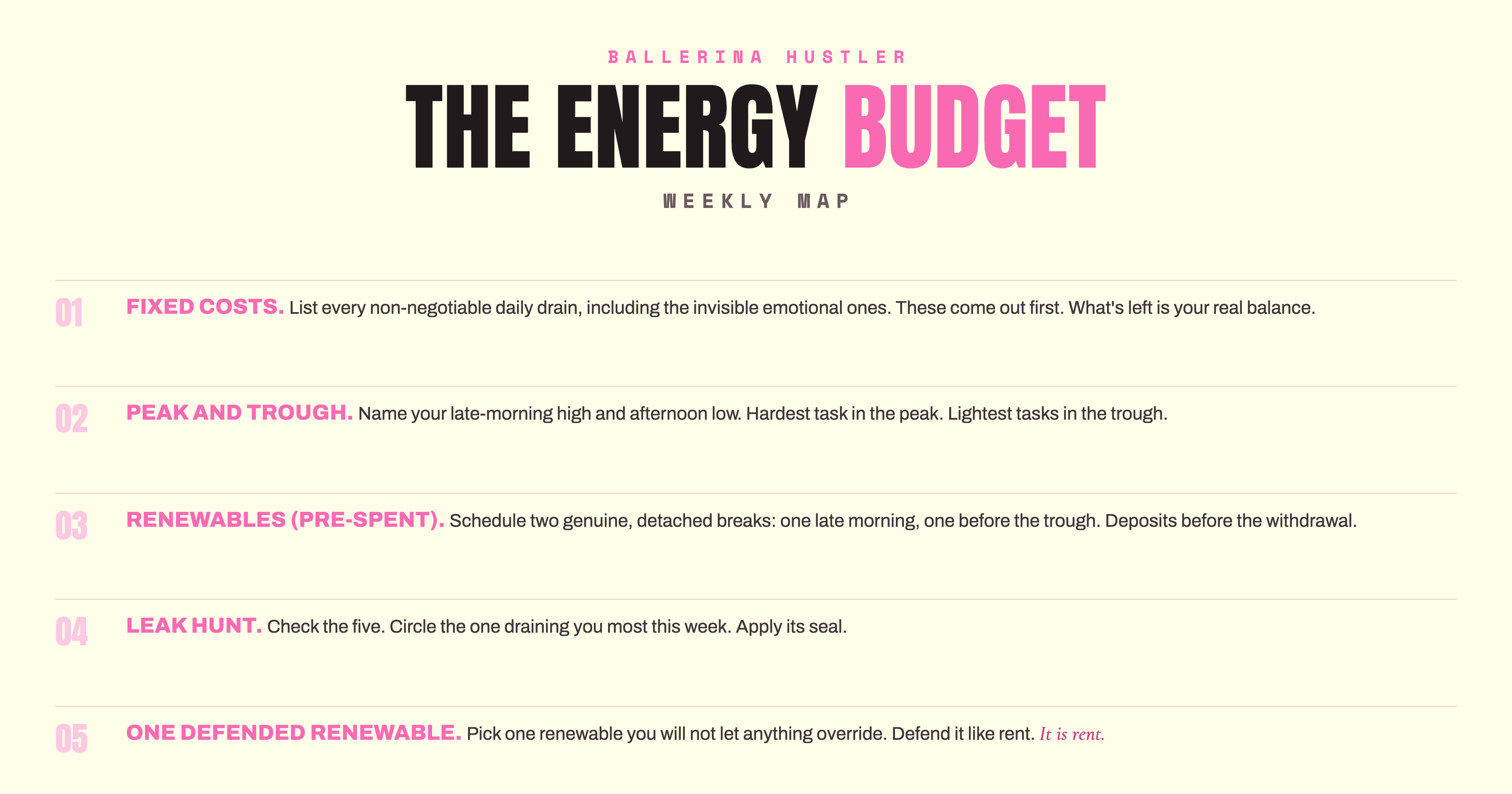
The one rule: you protect renewables before you spend on anything optional. A budget that funds every request and leaves nothing for deposits is the budget that goes bankrupt by three.
“But my job won’t let me”
A fair objection: “my calendar isn’t mine.” Real constraint, honest answer: you almost always control something.
Can’t move the hard task into your peak? At least stop volunteering optional hard things into your trough.
Can’t take a full walk? A genuine three-minute detachment, outside, fully off, still interrupts the habituation.
Can’t get thirty minutes to yourself? The five in the parked car before pickup, phone down, eyes up, still count. Small deposits are still deposits.
The budget works on a small account. You’re not after a perfect day. Just stop spending your richest hour on your cheapest work, and make one real deposit before the low.
The one thing to carry out of here
You were never bankrupt because you’re weak. You were bankrupt because you were spending a budget you couldn’t see.
Now you can see it. Fixed costs, renewables, leaks. Map it once, defend one renewable, seal one leak. That’s a solvent week.
— The Ballerina Hustler
Every physiological and neuroscience claim in this essay is sourced from peer-reviewed research and credited sources. For full citations, reply to this email. This essay is performance coaching, not medical advice, diagnosis, or therapy. For clinical concerns, please consult a qualified healthcare provider.
This is such a thoughtful and useful piece. You took something most of us treat as a personal failure and gave it a practical framework without pretending we can optimize our way out of being human. The distinction between managing time and managing energy is the part that will stay with me. A calendar can show where the hours went, but it can’t show how much of us each hour required.
This is such a familiar trap: sometimes a “framework” gives us more ways to justify staying stuck than actually making a decision. Looking forward to seeing where this goes!