


There's a kind of stuck that only finds you when you're almost there. You've done the hard part, the win is right in front of you, and your body quietly hits the brakes. You have a freeze response, and it shows up at the finish line.
You ship the deliverables. You meet the deadlines. You finish small things every day. But the launch? The pitch? The promotion you’d have to ask for? The application that’s been open in a browser tab for six weeks?
Something stops you within reach of the finish line. You can’t name it. You can’t think your way past it. By Sunday night, you’ve decided you’ll do it Monday. By Monday, the moment has cooled. By Friday, you’ve rebuilt your entire week around not doing it.
You know this pattern.
What’s happening in your body the closer you get to a big visible win isn’t laziness, fear of success, or a character flaw. It’s a threat response. The same nervous system that kept your ancestors alive on the savanna can’t tell the difference between “10,000 people are about to see me” and “a predator just spotted me.” It pulls the same emergency brake. Once you understand what’s happening, you can stop it, usually in under 60 seconds.
What your nervous system thinks “big visibility” means
In 1994, neuroscientist Stephen Porges introduced a framework for understanding the autonomic nervous system that’s now cited in nearly every modern conversation about trauma, anxiety, and performance. He called it polyvagal theory, and he published it in the journal Psychophysiology in 1995. The framework describes three states your nervous system cycles through: social engagement (you feel safe, you can think, you can connect), fight-or-flight (you sense danger, you mobilize), and the oldest state of all: freeze. Shutdown. Conservation. The body going still because the threat feels too big to fight or flee.
The freeze response is what shows up at the finish line.
Your body doesn’t have a separate threat-detection system for “the launch is in two days” and “there’s a bear in the woods.” There’s one system. It evolved when the most dangerous moment in our species’ history was the moment of high visibility: the moment we stepped out of the trees into the open, the moment we became prey, the moment a tribe could turn on us. Your brain inherited that wiring, and it doesn’t have a category for “the entire world is about to read my essay” that’s any different from “I’m being watched by something that wants to eat me.”
It pulls the brake. You freeze. You close the laptop. You’ll do it tomorrow.
Why this hits women harder
In 2004, NYU psychologist Madeline Heilman and her colleagues published a study in the Journal of Applied Psychology that’s now one of the most cited papers in the field of gender and work. They ran three experimental studies on reactions to women’s success. The finding: when women are acknowledged to have succeeded at male gender-typed tasks, they’re less liked and more personally derogated than equivalently successful men. There’s a measurable penalty for visibility, for ambition, for winning in a domain where women aren’t expected to win. Researchers call it the agentic backlash, and it’s been replicated dozens of times since.
So, when you stand at the edge of a launch or a pitch or a promotion, your nervous system isn’t being paranoid. It’s pattern-matching. It’s read the room before. It knows that visible ambition has historically cost women socially, professionally, and economically. The threat response your brain produces isn’t a malfunction. It’s accurate threat assessment about a real and documented penalty, layered on top of the ancient predator wiring that fires for everyone.
That’s why the freeze hits harder. That’s why the brake feels heavier. You’re not weaker. You’re carrying more.
You’re not afraid of success. Your nervous system is doing exactly what it evolved to do.
What ballet dancers know about spinning
There’s a moment in every classical ballet variation when a dancer does a series of turns (pirouettes, fouettés), and the room is, by physics, spinning around her at a speed that should make her lose her balance and fall. She doesn’t fall. She holds steady. She finishes the sequence, and lands clean.
What she’s doing is called spotting.
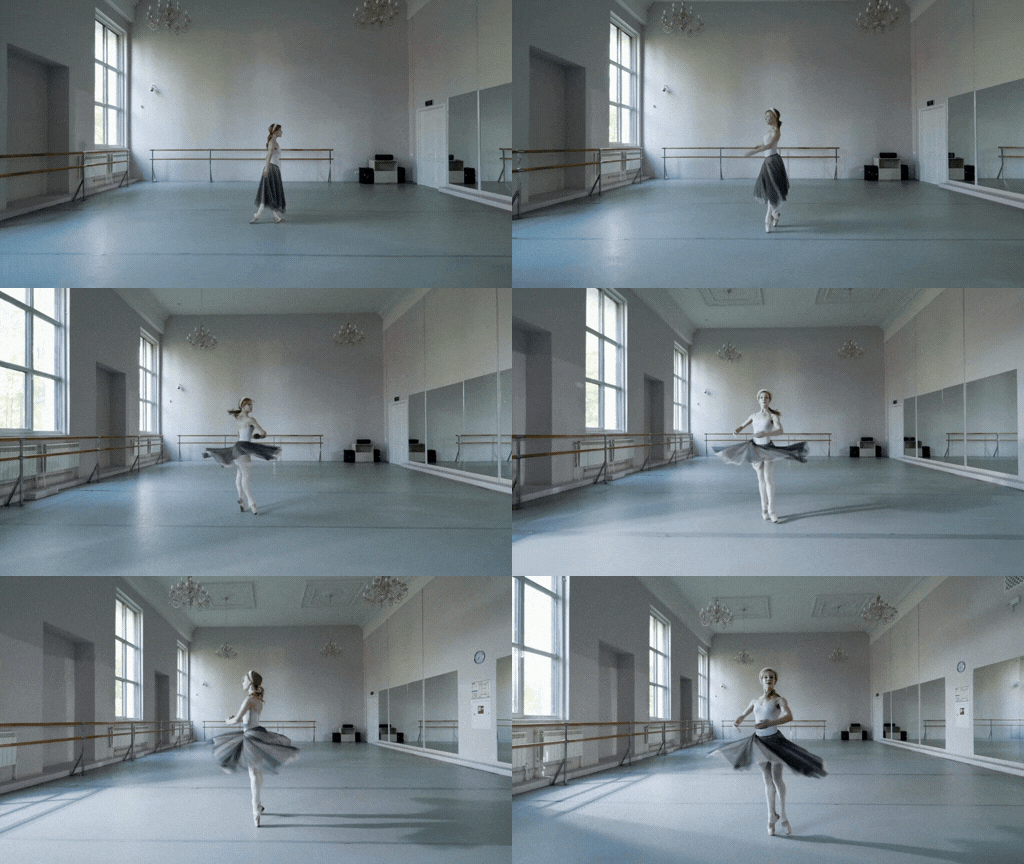
Spotting is the dancer’s technique of fixing her eyes on a single point in the room (a spot on the back wall, a marker on the audience, anything stationary) and returning her gaze to that exact same point on every rotation. Her body spins. Her head stays still to keep her eyes locked on the fixed point as long as possible, then whips around faster than her body to find it again for the next turn. The spot doesn’t move. She returns to it. The spinning becomes survivable because there’s one thing in the universe that’s still.
Without spotting, the spinning blurs together and the dizziness compounds with every turn. With spotting, she can land 32 in a row.
This is the principle behind the protocol that follows. When your nervous system is spinning, you feel it everywhere: the freeze rising in your chest, your hand refusing to move toward the publish button, your body locking up before the performance. That’s when you need a fixed point. The 3-step reset below is built around finding one.
The 3-Step Spotting Reset: SPOT, BREATHE, NAME
This protocol takes under 60 seconds. It’s designed to interrupt the freeze response in real time, the moment you feel it rise. Save this. Practice it once when you’re calm so your body knows the shape of it. Then use it when you need it.
Step 1: SPOT. Find a single fixed point in your physical environment. The corner of a window. A book on the shelf. A specific tree outside. Look at it. Let your eyes stay on it for 10 seconds without judgment, without analyzing, without scanning anywhere else. This is the orienting response, and it’s the most foundational intervention in modern somatic trauma therapy, developed and described by Dr. Peter Levine in his 2010 book In an Unspoken Voice. The act of visually orienting to a specific point in your environment signals to your nervous system that you’re not in motion, you’re not under attack, you’re here, and here is safe. Your body needs the visual data more than it needs your reassurance.
Step 2: BREATHE. Take a long exhale; longer than your inhale. The protocol with the strongest research backing is what Stanford researchers call cyclic sighing, published by Melis Yilmaz Balban and colleagues including David Spiegel and Andrew Huberman in Cell Reports Medicine in 2023: a double inhale through the nose, followed by a long, extended exhale through the mouth. One cyclic sigh runs about 10 seconds. Do it once. Do it twice if you have time. The extended exhale activates the parasympathetic nervous system through the vagus nerve, slowing your heart rate and pulling your body out of the threat state faster than any breathing pattern researchers compared it against.
Step 3: NAME. Out loud or in your head, label what’s happening. “My body is freezing. I’m not in danger. I’m about to do something brave.” Use whatever words are true. Naming takes about 20 seconds. The instruction sounds simple. The neuroscience underneath is precise: in a 2007 fMRI study published in Psychological Science, UCLA neuroscientist Matthew Lieberman and his colleagues showed that the act of putting feelings into words (what researchers call affect labeling) reduces activity in the amygdala, the part of the brain responsible for threat processing, and increases activity in the right ventrolateral prefrontal cortex, the part responsible for regulation and choice. Lieberman has described the effect as hitting the brakes on your emotional reactions. Naming the freeze interrupts the freeze.
Three steps. Under 60 seconds. SPOT. BREATHE. NAME.
When to use this
Use the Spotting Reset the moment you feel the freeze rise. Hand hovering over the publish button. The minute before the pitch. The second you sit down to send the email you’ve been avoiding. The wave you feel when you’re about to walk into an audition.
You don’t need to wait until you feel “ready.” You don’t need to think your way out of the threat response. You need a fixed point, a long exhale, and the right words. That’s it.
Use it before the launch. Use it before the leap. Use it the next time your body locks up at the finish line.
Save it. Send it.
The next time you’re about to step into something big, you don’t have to white-knuckle through it. You don’t have to wait until you feel confident. You can run the protocol. SPOT. BREATHE. NAME. Sixty seconds. Then you can press publish, make the offer, or walk onto the stage.
You know a woman who needs this today. The one who’s been “about to launch” for six months. The one with the application open in a browser tab. The one who keeps saying she’ll do it on Monday.
Save this for yourself. Send it to her.
That’s how we find each other.
— The Ballerina Hustler
Every neuroscience and performance psychology claim in this essay is sourced from peer-reviewed research and credited sources. For full citations, reply to this email. This essay is performance coaching, not medical advice or therapy; for clinical concerns, please consult a qualified healthcare provider.
Thanks for naming that feeling 🙏 it explains a lot…
Once again-great content thank you 🙏