

Barre note: You don’t have to stop the spin. You just need one place to look.
5 6 7 8
Happy Tuesday!
Welcome to Issue #027. Whether you danced at eight, dance now, have always wanted to, or simply love watching from the audience, you belong here. 💕 Pull up a spot at the barre.
New here? Every Tuesday we bring you one idea from neuroscience, embodiment, psychology or ballet, one thing to try the same day, and the study linked so you can check our work. It’s for the woman who carries a lot: in the studio, at work, in your business and at home. You don’t need to have danced a step to try any of this.
Today’s counts
The Lead: why a dancer’s brain can spin 32 times and barely feel dizzy, and how to borrow that steadiness when racing thoughts hit.
Embodied: a 5-minute kitchen-counter practice. No studio, no leotard.
From the barre: the one part of ballet class that almost never changes, and why we love it.
Ballet word of the day: Spotting
Choosing one fixed point and whipping your head around to find it again on every turn. Your eyes get a steady reference each time you come around, so the room stops smearing.
Pirouette puzzle: I stay still so she can spin. She finds me 32 times in one famous solo and never touches me. What am I? (Answer in Curtain Call.)
Brain Notes
The studies behind today’s issue, straight from the source:
◆ Why dancers don’t get dizzy. Imperial College London’s 2013 brain-scan study of ballet dancers and rowers. Read the Imperial news story
◆ Five minutes of sighing, on purpose. Stanford Medicine’s 2023 breathwork trial, with how to do a cyclic sigh. Stanford Medicine
◆ Putting feelings into words. UCLA’s 2007 affect-labeling study in Psychological Science. Read the paper
THE LEAD · NEUROSCIENCE
How to Stay Steady When Your Mind Won’t Stop Spinning (What Ballet Dancers’ Brains Already Know)
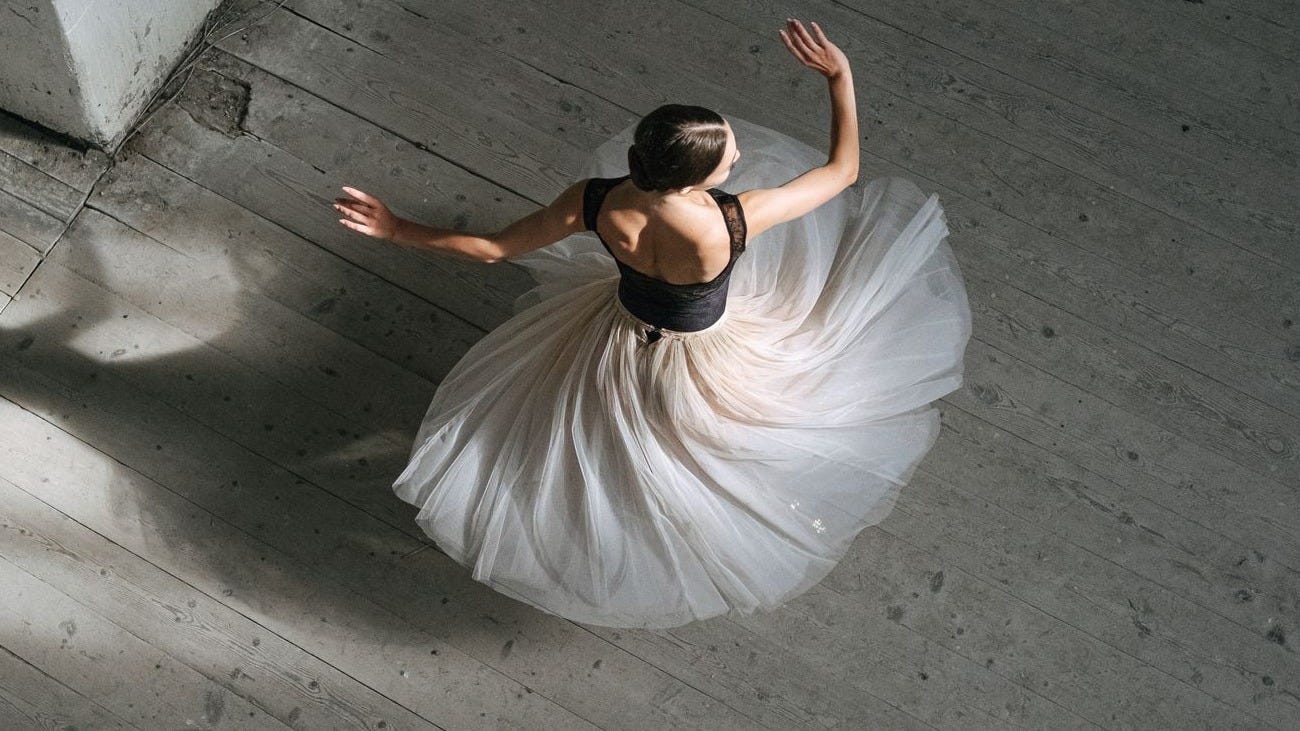
If your mind does its best spinning at night, same. It’s 11:00 PM, the laundry is still in the machine, tomorrow is already loud, and your brain is doing 32 fouettés with no intention of stopping.
Here’s the good news: steadiness isn’t just a personality trait. It can be trained, and ballet dancers show us how every night on stage. So let’s borrow from their brains.
1. Know that your brain can learn steadiness.
In a 2013 study, researchers at Imperial College London spun ballet dancers and rowers in a chair in a dark room, then asked how fast they still felt they were turning. The dancers’ sense of spinning faded faster, and it didn’t track their eye reflexes the way it did in the rowers. Brain scans showed less gray matter in a part of the cerebellum that processes signals from the inner ear, and dancers with more ballet training tended to have less. Study author Dr Barry Seemungal thinks years of training teach the brain to turn down that dizzy signal. (Imperial College London · the study) Translation: with years of practice, dancers’ brains seem to adapt. We think yours can learn too.
2. Pick your spot.
Dancers don’t fight the spin. They give their eyes one thing to come back to. Off stage, your spot can be tiny: a mug, a window, the feeling of your feet on the floor. When the thoughts start whirling, come back to it on purpose, again and again. That return is the rep. (We go deeper on spotting here.)
3. Make your exhale longer than your inhale.
In a month-long 2023 study from Stanford Medicine, people did 5 minutes a day of breathwork or mindfulness meditation. Cyclic sighing, which means two inhales through the nose and a long, slow exhale through the mouth, gave the biggest daily lift in positive mood, and it lowered people’s daily breathing rate, tracked by a wrist wearable, more than meditation did. (Stanford Medicine · the study)
4. Name the spin in a word or two.
In a 2007 brain-scan study at UCLA, people looked at photos of emotional faces and named the emotion they saw (not their own feelings). Naming it calmed the amygdala, the brain’s alarm center, more than other ways of looking at the same faces. It also boosted activity in a region at the front of the brain that may help regulate emotional reactions. So try it: “worried,” “overloaded,” “dreading Monday.” Short and plain is enough. (UCLA study, Psychological Science)
5. Mark it, don’t replay it.
Dancers “mark” choreography at half effort before they dance it full out. If one conversation is spinning in your head, mark it once: say what you want to say, out loud, at low volume. Then put it down. Replaying it at full volume at midnight is not rehearsal. (We go deeper on marking here.)
Try this today
Find your spot: one object in the room. Rest your eyes on it.
Do 3 cyclic sighs: in through the nose, a second top-up sip, then a long exhale through the mouth.
Name it: finish the sentence “Right now I feel...” in one or two words.
Carry it over
In the studio: before a turn, or the second you lose the combination.
At work: one fixed point and one long exhale before you speak in the hard meeting.
In your business: one thing to come back to on a day full of decisions.
At home: the 11pm laundry-brain spin.
Key takeaways
Steadiness can be trained. Dancers’ brains hint at how.
Give your mind one place to come back to.
A long, slow exhale is a brake you always carry.
Naming a feeling can help the alarm quiet down.
This is education, not medical advice, diagnosis or therapy.
EMBODIED
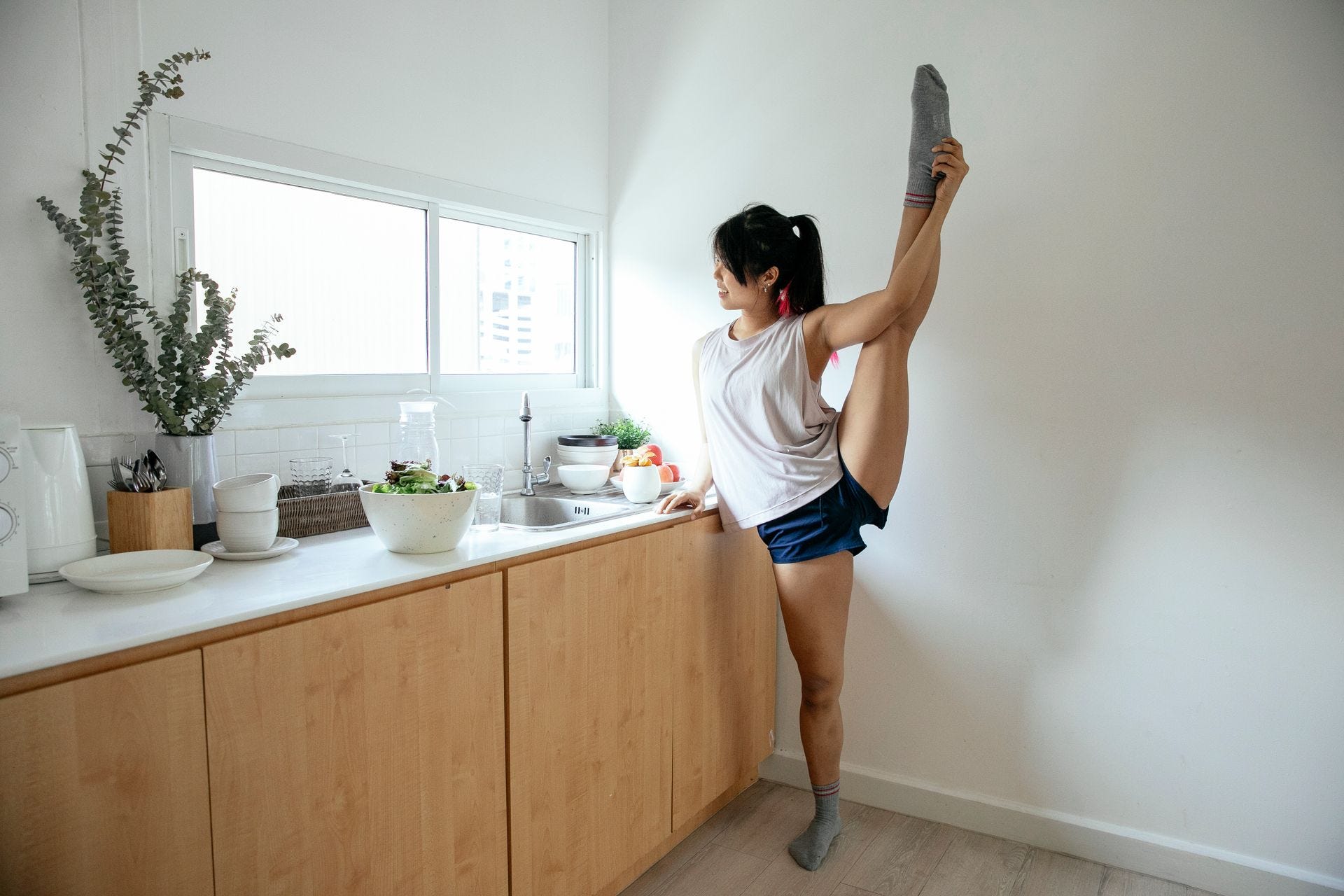
Your 5-minute kitchen-counter practice
No studio needed. A counter, a chair back or a sturdy windowsill is your barre.
Stand tall. Hands light on the counter, feet in a small V. Let your shoulders drop away from your ears.
Find your spot. Pick one point on the wall at eye level.
Rise and lower. 8 slow rises onto the balls of your feet, eyes on your spot. Lower for 4 counts each time.
Sigh it out. 3 cyclic sighs, still standing tall.
Balance. Take one hand off the counter for 8 counts. Switch hands.
Then, go through it once more.
Keep it gentle. Stop if anything hurts or you feel dizzy, and skip the balance if your ankles, knees or balance need extra care.
Want a real class near you? Tap the first option in the poll at the bottom (”What should we find for you?”). We’re building The Barre, our class finder, and your taps decide what comes first.
Ballet-Inspired Principle of the Week
Pull up.
Teachers say it a hundred times a class: pull up. It doesn’t mean suck in. It means lift from your center so your legs can move freely underneath you. The lift makes the rest lighter.
Off stage, pulling up looks like this: before a hard moment, find your center first. Feet on the floor, a longer spine, one long exhale. Then move. You’ll still carry a lot. It just won’t all land on your knees.
This week: every time you stand up from a chair, pull up for one breath before you walk away. At your desk, at the kitchen table, in the studio lobby. More ballet-inspired principles →
From the Barre
Almost every ballet class starts the same way: one hand on the barre, heels together, pliés. A professional company class and a Tuesday-night adult beginner class open in the same place.
We love that. Nobody is too advanced for the basics, and nobody is too new to start there. And on a week when your calendar looks like a Jackson Pollock, those first slow pliés might be the only thing that goes in order. Honestly? We’ll take it.
So here’s our hand-on-the-barre promise for this newsletter. Every Tuesday, same place: one idea, one practice, the study linked. You bring the coffee.
Quick answers:
How can I calm racing thoughts at night?
Try a 3-step reset from ballet class: find your spot, sigh, then name it. Rest your eyes on one object in the room, do 3 cyclic sighs (two inhales through the nose, then a long exhale through the mouth), and finish “Right now I feel...” in one or two words. This is education, not medical advice, diagnosis or therapy.
Why don’t ballet dancers get dizzy when they spin?
Years of training seem to teach their brains to turn down the dizzy signal. In a 2013 Imperial College London study, dancers’ sense of spinning faded faster than rowers’ after a chair spin. Dancers also had less gray matter in a cerebellum area that processes inner-ear signals, and dancers with more ballet experience tended to have less. Dancers also use spotting.
What is cyclic sighing?
Cyclic sighing is a breathing pattern: two inhales through the nose, the second a short top-up sip, then a long, slow exhale through the mouth. In a month-long 2023 Stanford Medicine study, 5 minutes a day gave the biggest daily lift in positive mood, and lowered daily breathing rate more than mindfulness meditation did.
Does naming your emotions help?
It can. In a 2007 UCLA brain-scan study, people named the emotion shown on photos of faces (not their own feelings), and that lowered the response of the amygdala, the brain’s alarm center, compared with other ways of processing the same faces. It also raised activity in a front-of-brain region that may help regulate emotional reactions. One or two plain words is enough.
Sources cited in this issue
Nigmatullina Y, Hellyer PJ, Nachev P, Sharp DJ, Seemungal BM (2015, online 2013). The neuroanatomical correlates of training-related perceptuo-reflex uncoupling in dancers. Cerebral Cortex, 25(2), 554–562. Imperial College London. https://academic.oup.com/cercor/article/25/2/554/305011
Balban MY, Neri E, Kogon MM, et al. (2023). Brief structured respiration practices enhance mood and reduce physiological arousal. Cell Reports Medicine, 4(1), 100895. Stanford Medicine. https://www.cell.com/cell-reports-medicine/fulltext/S2666-3791(22)00474-8
Lieberman MD, Eisenberger NI, Crockett MJ, Tom SM, Pfeifer JH, Way BM (2007). Putting feelings into words: Affect labeling disrupts amygdala activity in response to affective stimuli. Psychological Science, 18(5), 421–428. UCLA. https://journals.sagepub.com/doi/10.1111/j.1467-9280.2007.01916.x
Curtain Call
Your story could go here. Changed a pattern, went back to class after 20 years, finally booked the trial? Tell us in a few lines and we may share it, with your OK. Send us your story →
This week’s ballet to watch: Swan Lake, Act III, the Black Swan coda. Watch her head, not her feet, during the 32 fouettés. That snap back to the front, every single turn, is spotting. Many companies post clips on their official YouTube channels.
What should we find for you? One tap. We’re building this next, and you decide what comes first.
Find a ballet class near me → (Search by level, style or neighborhood.)
A professional coach → (Just pick the type and your city. No health info needed.)
Pirouette puzzle answer: her spot. See why →
Coming soon: PRIMA
We’re building PRIMA, an always-on AI performance companion for the moments that ask a lot of you, in the studio, at work, in your business and at home: steady the body, clear the mind, then act. It’s built on Neuro-Embodied Performance Practice™ (NEPP). It’s an AI companion, not therapy.
Waitlist members get first access to a free trial. Join the PRIMA waitlist →
Hit reply and tell us what landed. We read every note.
See you at the barre,
The Ballerina Hustler team
P.S. Know someone whose mind won’t stop spinning? Forward this to her. She can get the free newsletter here.
Ballerina Hustler™ is a weekly newsletter on neuroscience, embodiment, psychology and ballet-inspired principles. The science in this issue comes from peer-reviewed research, listed in the sources above. This is performance coaching, not medical advice, diagnosis or therapy. For clinical concerns, please see a qualified healthcare provider. If you’re in crisis in the United States, call or text 988.
What a great and helpful article this is!! I've never danced ballet but always admired however I love to dance. The kitchen exercise is super simple and I enjoy doing it, so this was a great reminder. Also exhales longer than inhales, something I always keep in mind when doing deep breaths for deep relaxation ❤️
“mark it, don’t replay it” is the line I kept thinking about. Framing the midnight loop as full-volume rehearsal makes it easier to see why it feels productive when it usually isn’t. Saying it once out loud at low volume is a concrete substitute, not just advice to stop thinking.