

Today is National Teacher Appreciation Day.
Which means today, somewhere, a mother will bring her daughter to your studio with a Starbucks card and a handwritten note, and you’ll say thank you, and you’ll mean it, and you’ll put the card in the drawer with the other ones because you haven’t had 20 minutes alone to read anything in months.
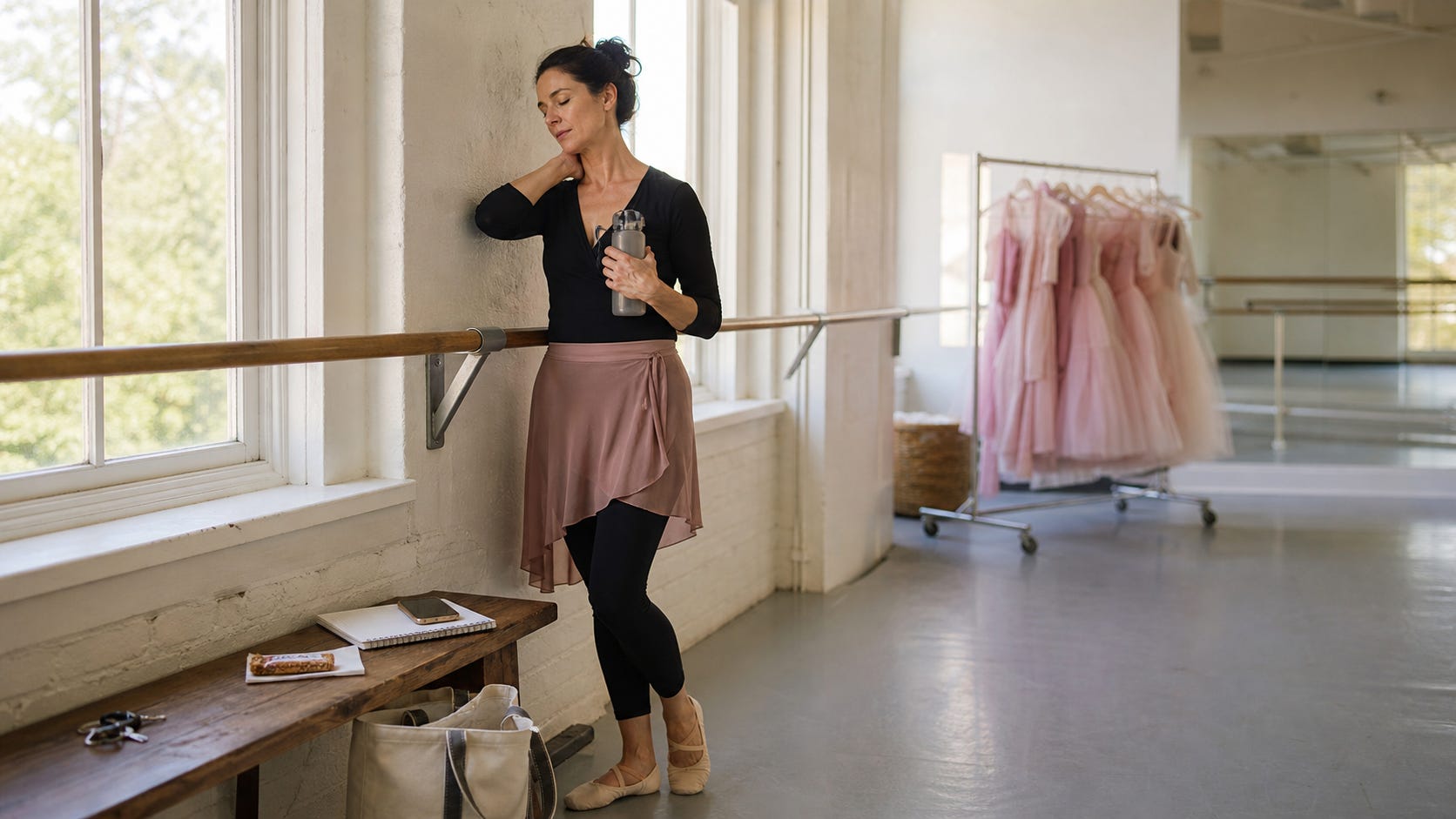
Then you’ll teach your 9:30 am class. Then your 10:45 am. Then your 12:30 pm. You’ll answer three texts about costumes between classes. You’ll field a call from the mother whose daughter is “feeling left out” of the competition piece. You’ll notice the studio bathroom needs toilet paper. You’ll make a mental note to email the insurance broker. Your own lunch will be a protein bar that you’ll be eating while standing at the front desk between students.
By 3:00 pm your lower back will be doing that thing it does in May. By 9:00 pm you’ll be home, finally, and you’ll sit in the car in your driveway for 10 minutes because you don’t yet have the energy to walk inside and parent the people who live in your house.
You own this studio. You chose this. You love this.
And you’re so tired that you’ve started to forget what your own body feels like when it’s not in recital prep.
Why we’re writing to you today
Because we appreciate you and care for you.
Every May, every dance studio in the US enters a specific kind of hell that lasts six to eight weeks. Costumes arrive wrong. The recital venue changes a rule. Three mothers email you the same question on the same day. A child who’s been dancing with you for nine years decides she wants to quit right before the competition. A parent posts something passive-aggressive in the studio Facebook group. The dry cleaner loses a tutu.
And through all of it, you’re teaching 15-25 hours a week of actual classes.
The body pays for this. Studies of professional dance teachers have found that roughly three out of four report chronic orthopedic complaints, most commonly in the lower back, hips, knees, and feet. More than half of them connect those complaints directly to the physical demands of their work, specifically citing pressure of expectation and tight scheduling as contributing causes.
This isn’t a metaphor. Your back isn’t hurting because you’re “stressed.” Your back is hurting because you’re physically teaching dance AND running a business AND performing emotional labor for other people’s children for eight to 10 hours a day in May. The tissue is telling you something.
You’re not a dance teacher who also happens to run a business. You’re a small business owner who is physically on the dance floor 20 hours a week during recital season. That’s two full-time jobs in one body.
What’s actually depleting you
Here’s the thing nobody names out loud: physical exhaustion isn’t what’s breaking you.
What’s breaking you is emotional labor. It’s the term researchers use for the work of managing your own emotions, and everyone else’s, while you do the actual job. It’s staying calm when a nine-year-old is melting down about her costume fitting. It’s performing patience you don’t feel so the six-year-old in front of you doesn’t know you’re running on three hours of sleep. It’s holding space for other people’s feelings all day, every day, for years.
Researchers call the specific kind of emotional labor that drains you the most “surface acting” — when what you’re feeling on the inside doesn’t match what you’re showing on the outside. A recent meta-analysis of 85 studies involving over 33,000 teachers found that surface acting is consistently and significantly associated with emotional exhaustion and burnout. This is the largest body of research on teacher well-being in the field, and the finding has been replicated across countries, school types, and age groups.
And studio owners are in a worse position than most teachers. You’re performing the emotional labor of a teacher AND a business owner AND, often, the unofficial therapist of every dance family who walks through your door.
This is why you feel like a different person at home. This is why you snap at the people you love. This is why your body hurts in ways that don’t make sense for the hours you actually worked. You didn’t work 10 hours today. You worked 10 hours and managed 10 hours of other people’s feelings on top of that. The body doesn’t distinguish. The nervous system just keeps paying the bill.
The 15-minute reset between classes
Here’s what you’re probably doing in the 15 minutes between your classes right now: checking email, answering a parent text, prepping music for the next class, grabbing water, maybe eating something, responding to a staff question, dealing with whatever went wrong in the class that just ended.
That’s not a break. That’s context-switching. Your nervous system never actually transitions out of teach mode. It just switches to a different form of performance.
We want to propose something different. Not a radical overhaul.
A 15-minute protocol you can do in your office, your car, or a bathroom with a locked door:
1. Leave the role (3 minutes) - physical relocation + park-it-on-paper
2. Reset the body (5 minutes) - cyclic sighing
3. Enter the next role (7 minutes) - water, protein, music entrainment, one sigh, walk back in
1. Leave the role. (3 minutes)
The class you just taught — that version of you — has to go somewhere. If you don’t put it down, you carry it into the next class.
Step out of the studio. Not metaphorically. Physically. Walk out of the room where you just taught. Go to your office, your car, a different room, outside. The physical relocation matters because your nervous system associates the teaching space with teaching activation. You can’t park the role in the same room where you perform it.
For three minutes, do nothing. Don’t check your phone. Don’t prep for the next class. Sit. Put your feet flat on the floor. Let your jaw unclench. Let your shoulders drop. You didn’t know they were up, but they were.
If a thought from the class you just taught comes up, acknowledge it and write it down on a scrap of paper. Not to solve it. Just to park it. Writing it down is how your brain releases the obligation to keep looping on it.
2. Reset the body. (5 minutes)
This is where most teachers skip to the next task. Don’t. This is the part that makes the rest of the day possible.
Five minutes of cyclic sighing. This is the breathwork protocol that came out of a Stanford clinical trial published in Cell Reports Medicine in 2023. Researchers compared it to mindfulness meditation and several other breathing techniques, and cyclic sighing produced the greatest improvement in mood and the largest reduction in physiological arousal in the study.
It’s simple. Breathe in through your nose. Then, at the top of that inhale, add a second short inhale: a little sip of air that fills whatever space is left in your lungs. Then, exhale slowly and completely through your mouth. That’s one cycle.
The double inhale reopens the small air sacs (alveoli) in your lungs that collapse during shallow stress breathing. The long exhale triggers parasympathetic activation through the vagus nerve, which is the system responsible for lowering heart rate, slowing your breathing, and signaling to your body that the threat is over.
Do this for five minutes. Your respiratory rate will drop. Your shoulders will release. Your jaw will unlock. This is not a trick. It’s the actual physiological reset your body has been waiting for since your first class this morning.
One important note: if your body wants to cry at some point during this five minutes, let it. Crying IS parasympathetic activation. It means the system that was stuck on high alert is finally safe enough to come down. Don’t interpret tears as weakness. Interpret them as the evidence the protocol is working.
3. Enter the next role. (7 minutes)
You’re not going back to where you were. You’re starting something new. Treat it that way.
The last seven minutes are for preparing. But prepare as yourself, not as the last-class version of yourself.
Drink water. Not a sip. A glass. Dance teachers chronically underhydrate, and dehydration directly increases cortisol, muscle tension, and fatigue. If you do nothing else between classes, drink the water.
Eat something with protein. A handful of almonds, or a bar that has actual protein and not just sugar. Your brain runs on glucose, but your mood runs on stable blood sugar. The 3:00 pm crash you’ve been blaming on “how May feels” is frequently a blood sugar crash from not eating between classes.
Put on the next class’ music. Not mentally review the next class. Physically put on the music. Your nervous system entrains to rhythm. Letting your body hear what it’s about to do shifts you through the body, not the mind.
Take one full breath and then walk back into the studio.
The truth about actually doing this
You’re going to read this and think: “I don’t have 15 minutes between classes!”
We know. We’re asking you to find them anyway. Not because we don’t respect what your schedule looks like but because we’ve seen what happens to teachers and studio owners who don’t.
The woman who owns the studio but teaches seven classes a day during recital season without a break is not more dedicated than the woman who takes the 15 minutes. She’s closer to the injury that ends her season. She’s closer to the moment a parent’s complaint breaks her because she has nothing left. She’s closer to the morning in late May when she wakes up and can’t physically get out of bed.
Fifteen minutes is not self-care. Fifteen minutes is operational discipline.
The break between classes is NOT wasted time. It’s the reason the next class is any good. Without it, you’re not teaching the next class. You’re performing the muscle memory of a teacher while your nervous system falls apart underneath.
If you made it to the end of this essay
You’re the woman we wrote it for.
Do one thing for yourself, before you teach your last class today: take 15 minutes between now and then. Go somewhere that isn’t the studio floor. Sit. Breathe. Drink water. Eat something. Walk back in as a person and not a performance.
You’ve taught hundreds of children how to come back to their center when they lose their balance. We’re asking you to do it for yourself.
The studio will still be there in 15 minutes. And the teacher who walks back in will be better for the children, for the business, and for the woman who goes home at the end of the day.
— The Ballerina Hustler Team
Discipline. Performance. Psychology. For women who refuse to break.
Every physiological and neuroscience claim in this essay is sourced from peer-reviewed research. For citations, reply to this email. This essay is performance coaching, not medical advice or therapy; for clinical concerns, please consult a qualified healthcare provider.
This is true. On the other hand, your communication with music, dance and beauty gives depth and inner feelings beyond the ordinary.
Thank you for this poweful text! This is enormous pressure and your recommendations fall at the heart of the problem, giving real solutions.