

Barre note: You belong at the barre before you believe it. Let your body go first.
5 6 7 8
Happy Tuesday!
Welcome to Issue #031. Last week: is it too late to start ballet? This week: how to stop hiding in the back corner. 💕
New here? Every Tuesday we bring you one idea from neuroscience, embodiment, psychology or ballet, one thing to try the same day, and the study linked so you can check our work. It’s for women who dance, danced, or always wanted to, and who carry a lot: in the studio, at work, in your business and at home. You don’t need to have danced a step for any of this to work.
Today’s counts
The Lead: why you shrink in class, and five ways to take your space.
Center: the sorry list.
Embodied: a five-minute arrival practice.
From the Barre: Martha Graham on a dancer’s training.
Ballet word of the day: Pas marché
French for “marching step.” American Ballet Theatre calls it “the dignified, classical walk of the ballerina.”
Pirouette puzzle: My heels sit on one line, about a foot apart. I’m open, and I take my space. What am I? (Answer in Curtain Call.)
Brain Notes
The research behind today’s issue, straight from the source:
◆ Posture and mood. A 2022 review of 88 studies. Read the summary
◆ “Do not say sorry.” One adult ballet teacher’s rule. Read Seattle Met
THE LEAD · EMBODIMENT
The Back Corner: How to Take Up Space in Ballet Class When You Feel You Don’t Belong
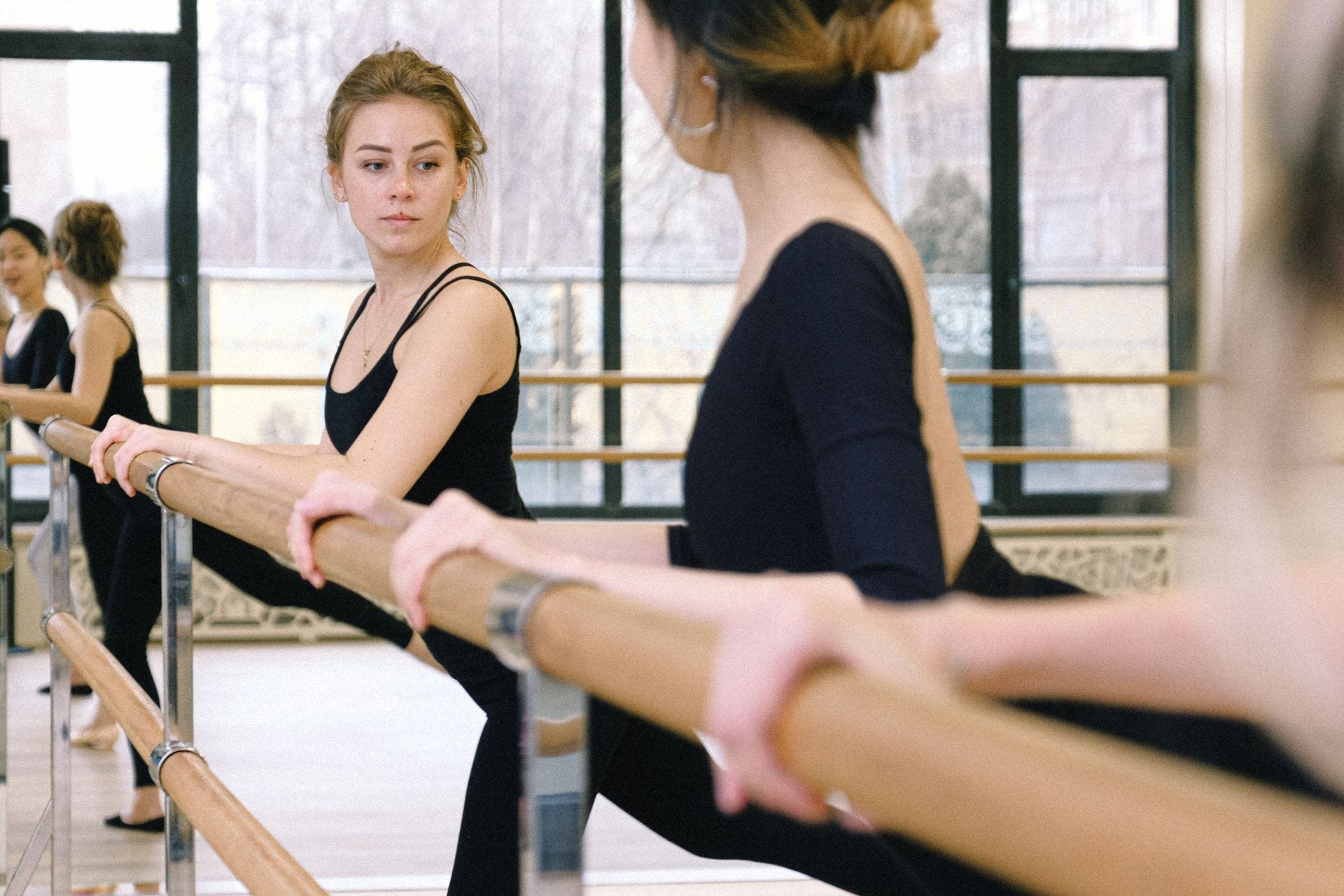
It’s 6:55 PM. The studio door sticks, the floor smells like wax, and music is already playing. You say sorry to the woman stretching by the door, sorry to the teacher, sorry to a bag you nearly step on, even sorry to the barre when you bump it. Then you take the back corner, half hidden by the door.
“I’ve been there. I used to stay at the back a lot. I was afraid to make a mistake, and I needed someone in front of me to follow. Now I’m inching towards the front.”
—Sandra, founder of Ballerina Hustler
Your body decided you don’t belong before the music started. Shrinking, saying sorry and hiding in the back are body habits. Habits can change, one class at a time.
1. Notice the shrink.
Miriam Landis teaches adult beginners on Mercer Island, near Seattle. She told Seattle Met that a lot of people come in “very apologetic.” They “try to do the combination, and then they’ll say sorry, or they’ll make a face.” Her answer: “Do not say sorry.” (Seattle Met)
The writer who took her class noticed a house rule: “we can only talk kindly about ourselves.” That’s one teacher and one class, not a study. Notice your own version. Do your shoulders round? Do you grab the end of the barre? You can’t change a habit you haven’t seen.
2. Stop folding.
In 2022, psychologists in Germany and the United States pooled 88 studies with 9,779 people. Each study randomly put people in different body positions, then checked how they felt or acted. Upright, they “felt better and were more confident” than hunched, and that held across ages and in Western and Eastern countries. There was no evidence posture changed hormones, and the team can’t yet say how long the feeling lasts. (APA summary; Körner and colleagues, 2022)
So skip the big pose. Stop folding. Ballet has a calm, ready stance: bras bas, which ABT calls “the dancer’s ‘attention.’” (ABT) Arms low and rounded, shoulders easy. Why low arms? They give your hands somewhere to rest.
3. Ask the studio what to wear.
Dress codes vary. Pacific Northwest Ballet School asks adults for “ballet appropriate clothing that allows for fluid movement during class.” (PNB) The Washington Ballet’s adult program suggests “fitted dancewear, athletic wear, or activewear” that “stays in place during physical activity.” (The Washington Ballet)
Why ask? Because a lot of hiding starts in the changing room. Our quick test: can you bend and reach without tugging? If yes, that’s one less pull toward the corner.
4. Take your arm’s length.
Rest one hand on the barre and open your other arm to the side. That’s your space. PNB’s studio rules ask students to “Stand behind the teacher and give them space” and to “Be spatially aware of others.” (PNB)
Why an arm’s length? It’s a space you can measure without asking anyone. You don’t need the front spot. You need a spot you picked. The back is fine if you chose it. Landis calls class “a really good exercise in just bringing forth your true self.” (Seattle Met)
5. Swap “sorry” for “hi, I’m new.”
Studios expect new people. PNB’s Fundamentals I description opens: “Have you always wanted to try ballet but felt too intimidated? This is the class for you!” (PNB)
So walk in and say “Hi, I’m new.” It tells the teacher what you need, and it reminds you that you have a right to be there. When you miss a step, skip the sorry, breathe and find the next count. This swap is our suggestion, not a study. New isn’t wrong. It’s just new.
Try this today
Ask the studio: “What should I wear to my first class?”
Say “Hi, I’m new” out loud once, so it’s ready.
Catch one sorry today you didn’t need, and let it go.
Carry it over
At work: in your first meeting in a new role, skip the chair by the door.
In your business: say your price without a sorry in front of it.
At home: step into the family photo instead of out of it.
Key takeaways
Shrinking and saying sorry are body habits. Habits can change.
Ask what to wear, then pick your spot on purpose.
New isn’t wrong. It’s just new.
CENTER · PSYCHOLOGY
The sorry list
A lot of sorries are really a question: “Is it OK that I’m here?” Yes. You paid for the class.
Your exercise: the sorry list (60 seconds)
Write down three things you said sorry for this week that weren’t wrong. Next to each, write a swap. “Sorry, quick question” becomes “I have a question.”
EMBODIED
Your five-minute arrival practice
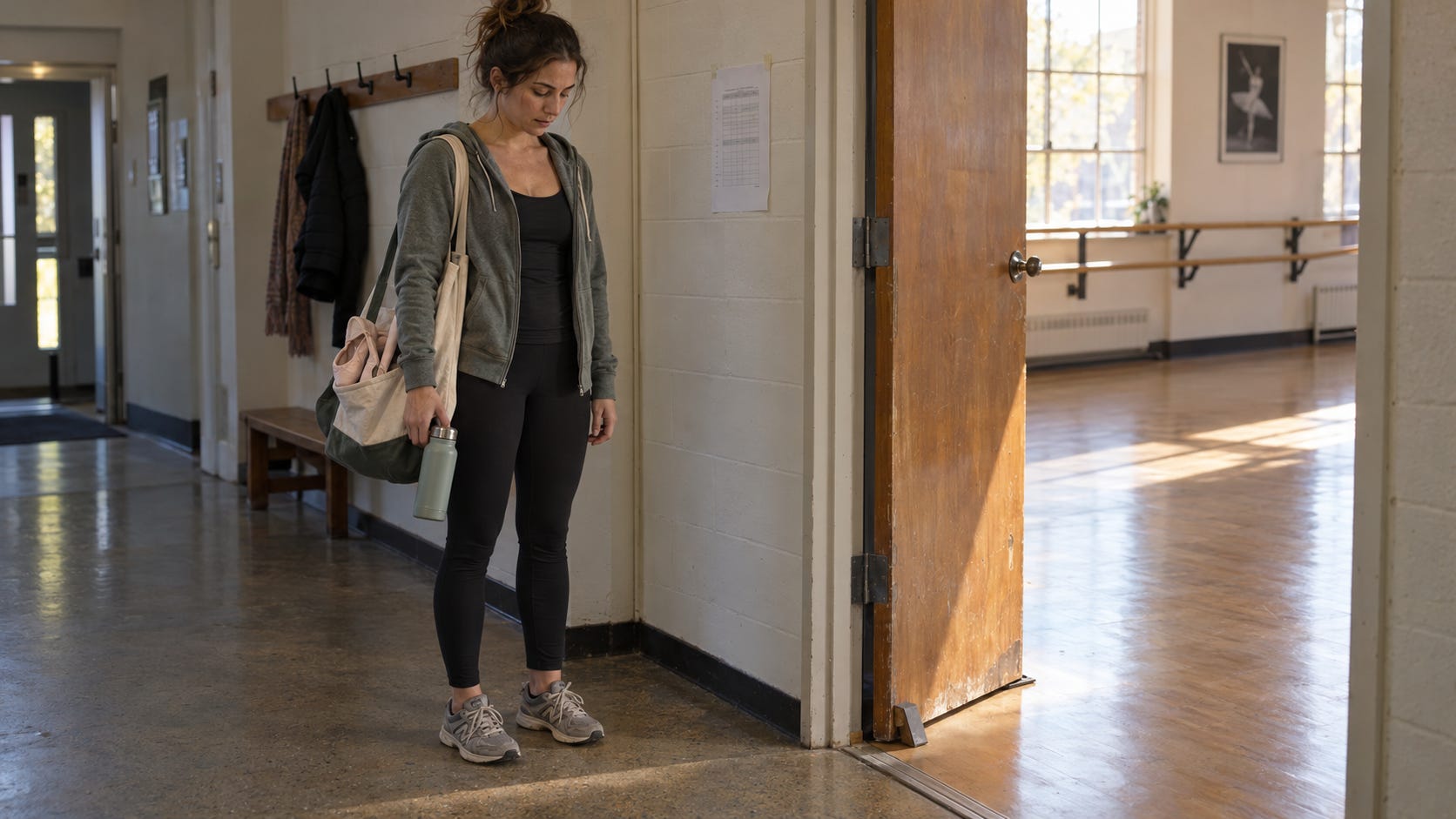
Five minutes for your body + brain, from the car to the barre.
Arrive early. About 10 minutes before class.
Plant both feet. Stand still, weight even. ABT describes the plié with “the whole foot grasping the floor.” (ABT) Take three slow breaths, the out-breath a little longer.
Walk in like a pas marché. Head level, steps even.
Settle in bras bas. At your spot, arms low and rounded, shoulders easy. One slow breath out.
Keep it gentle. Stop if anything hurts or you feel dizzy, and check with your doctor or physical therapist first if your balance needs extra care.
Ballet-Inspired Principle of the Week
Open to second.
In ballet, second is an open position. In American Ballet Theatre’s words, the feet “are on the same line but with a distance of about one foot between the heels.” ABT’s word for it is ouvert: “Open, opened.” Off stage, second looks like this: when you catch yourself squeezed into the edge of a room, step out to your width. (ABT Ballet Dictionary)
This week: take your full spot before you speak. More ballet-inspired principles →
From the Barre
In her essay for the radio series This I Believe (aired around 1953), Martha Graham wrote about a dancer’s training: “The body is shaped, disciplined, honored and in time, trusted.” (NPR archive)
Quick answers
How do I feel less awkward at my first adult ballet class?
To feel less awkward at your first class, start with your body. Arrive about 10 minutes early, plant both feet and take three slow breaths. Then tell the teacher “Hi, I’m new” instead of saying sorry. This is education, not medical advice.
Does posture affect confidence?
Posture may affect how confident you feel. In a 2022 review of 88 studies, psychologists in Germany and the United States found people upright “felt better and were more confident” than people hunched. There was no evidence posture changed hormones, and it’s unclear how long the feeling lasts.
What is bras bas in ballet?
Bras bas is ballet’s calm, ready stance: arms low and rounded, shoulders easy. American Ballet Theatre calls it “the dancer’s ‘attention.’” Try it at your spot before class starts. Just stop folding, let your arms rest low and breathe out.
Curtain Call
Your story could go here. Did you move out of the back corner? Tell us, and we may share it with your OK. Send us your story →
This week’s ballet to watch: Watch Dorothée Gilbert walk toward you in the Paris Opera Ballet’s Défilé. Notice how slow and tall each step is. (Opéra de Paris)
Pirouette puzzle answer: second position. See why →
Coming soon: PRIMA
We’re building PRIMA, an AI companion for performance and life’s big moments, and a guided reflection practice. It’s an AI companion, not therapy. Waitlist members get first access. Join the PRIMA waitlist →
Hit reply and tell us what landed. We read every note.
See you at the barre,
The Ballerina Hustler team
P.S. Know someone who takes the spot by the door? Forward this. She can subscribe here.
Ballerina Hustler™ is a weekly newsletter on neuroscience, embodiment, psychology and ballet-inspired principles. The science in this issue comes from peer-reviewed research, listed in the sources below. This is education, not medical advice, diagnosis or therapy. For clinical concerns, please see a qualified healthcare provider. If you’re in crisis in the United States, call or text 988.
Sources cited in this issue
Körner R et al. (2022). Dominance and prestige: Meta-analytic review of experimentally induced body position effects. Psychological Bulletin.
American Psychological Association (2022). Standing tall and standing wide. Research Spotlight.
Shapley H (2026). Grown-Ups Are Going to Ballet Class. Seattle Met.
Graham M (c. 1953). An Athlete of God. This I Believe, NPR.
Bonus: First Class Confidence
Part 1: your car-to-barre walk-in script
In the car: feet flat, three slow breaths. Say, “I’m allowed to be new.”
At the door: head level, pas marché pace.
To the teacher: “Hi, I’m new. Anything I should know?”
At the barre: pick your spot.
Part 2: two questions to ask a studio
What should I wear to my first class?
Which class do you suggest for a brand new adult?
As a yoga teacher I see the back corner thing in my classes all the time. New people go straight to the spot by the door and say sorry for everything. “Hi, I’m new” is such an easy swap! 😊