

You’re not jealous of her. You’re in fight-or-flight.
It’s 9:47 on a Tuesday night. You meant to look at your phone for two minutes. It’s been 50.

Somewhere between her sourdough and her promotion announcement and her kid’s spelling bee trophy and the perfectly lit hallway of her renovated foyer, something happened in your body. Your chest got tight. Your shoulders climbed an inch. You can feel your pulse in your jaw. You’re still in your same kitchen. Nothing has actually happened to you. But your nervous system is convinced something has.
You put the phone face-down. You tell yourself you’re being ridiculous. That you’re happy for her. That you’d never want her life anyway. That comparison is the thief of joy, and you know better, and you’re going to scroll less tomorrow.
You won’t scroll less tomorrow. And it has nothing to do with willpower.
What you’re feeling isn’t jealousy. It isn’t pettiness, or insecurity, or some character flaw you have to therapize out of yourself. It’s a 70,000-year-old survival circuit firing exactly the way it was designed to fire. And it doesn’t know the difference between your neighbor outperforming you on the savanna, and a woman you’ve never met posting a reel of her kitchen island.
Your brain thinks you’re losing ground. Your body is preparing to fight for ground. There’s no ground. There’s only your phone.
What’s happening in your brain when you scroll
In 1954, a social psychologist named Leon Festinger published a paper that quietly reshaped how we understand human self-knowledge. He called it social comparison theory. His argument was simple: when we don’t have an objective way to measure ourselves (how smart we are, how successful, how attractive) we measure ourselves against other people. We can’t help it. It’s how the brain figures out where it stands.
For most of human history, that mechanism worked because the comparison group was small. You had maybe 150 people in your life. You knew them. You saw them sweat, fail, get sick, lose their patience with their kids. The comparison was lived, three-dimensional, full-context.
Now your comparison group is six million strangers, every one of whom has selected and edited the 0.3 percent of their life worth posting. You’re comparing your inside to their outside. You’re comparing your unedited Tuesday at 9:47 PM to a year of their best lighting.
And your brain is taking it seriously. As if your survival depends on it.
Neuroscientist Naomi Eisenberger and her colleagues at UCLA have spent two decades showing what happens in the brain during this kind of social wounding. In a landmark line of research, Eisenberger demonstrated that social pain (rejection, exclusion, feeling left behind) activates many of the same neural regions as physical pain. The dorsal anterior cingulate cortex. The anterior insula. The same circuits that fire when you stub your toe or burn your hand.
Your brain doesn’t have a separate folder for “she’s ahead of me on Instagram.” It files that experience in the same drawer as actual injury.
The alarm system at the center of all of this is your amygdala: the small almond-shaped structure deep in your brain whose only job is to scan for threat. The amygdala doesn’t do nuance. It doesn’t do context. It doesn’t know the difference between a bear and a feed. It just sees: she has it, I don’t, I’m behind, I’m in danger. And it fires.
That tightness in your chest? Cortisol. That climbing pulse? Adrenaline. That sudden urge to do something, anything, fix something, prove something? That’s your body preparing to fight for ground that doesn’t exist.
You’re not weak. You’re not vain. You’re a mammal running ancient software on a piece of glass.
You’re not jealous. You’re a mammal running ancient software on a piece of glass.
Why women feel the comparison spiral harder
If you’ve ever wondered why this hits you in a way it doesn’t seem to hit the men in your life, you’re not imagining it.
For women, the comparison engine isn’t running on one track. It’s running on five at once. Career. Body. Motherhood. Marriage. Personal growth. “Am I aging well.” “Is my house clean.” “Am I a good friend.” “Do I look rested.” “Am I doing enough.” Each one of those has its own comparison group, its own benchmark, its own perfectly lit account telling you what you should be.
There’s no version of a woman’s life that the internet won’t find a way to make her feel behind in.
A man scrolls and sees a guy with a nicer car. A woman scrolls and is told, in the same five minutes, that she should also have a smaller waist, a more peaceful marriage, a child who reads above grade level, a more impressive title, a more interesting hobby, a cleaner house, a better skincare routine, and a more spiritual relationship with her own aging. The cognitive load of that comparison isn’t equal. It’s exponential.
The women who feel it hardest aren’t the women you’d expect. They’re not the women who are “doing the least.” They’re the women who are doing the most. Because high-functioning women have the most surface area for comparison. The more roles you carry, the more directions you can be told you’re behind in.
This isn’t a personal failure. It’s a structural one. The comparison spiral isn’t a sign that there’s something wrong with you. It’s a sign that the system is doing exactly what it was designed to do, and you happen to be the woman it’s working on.
What a ballerina knows about the mirror
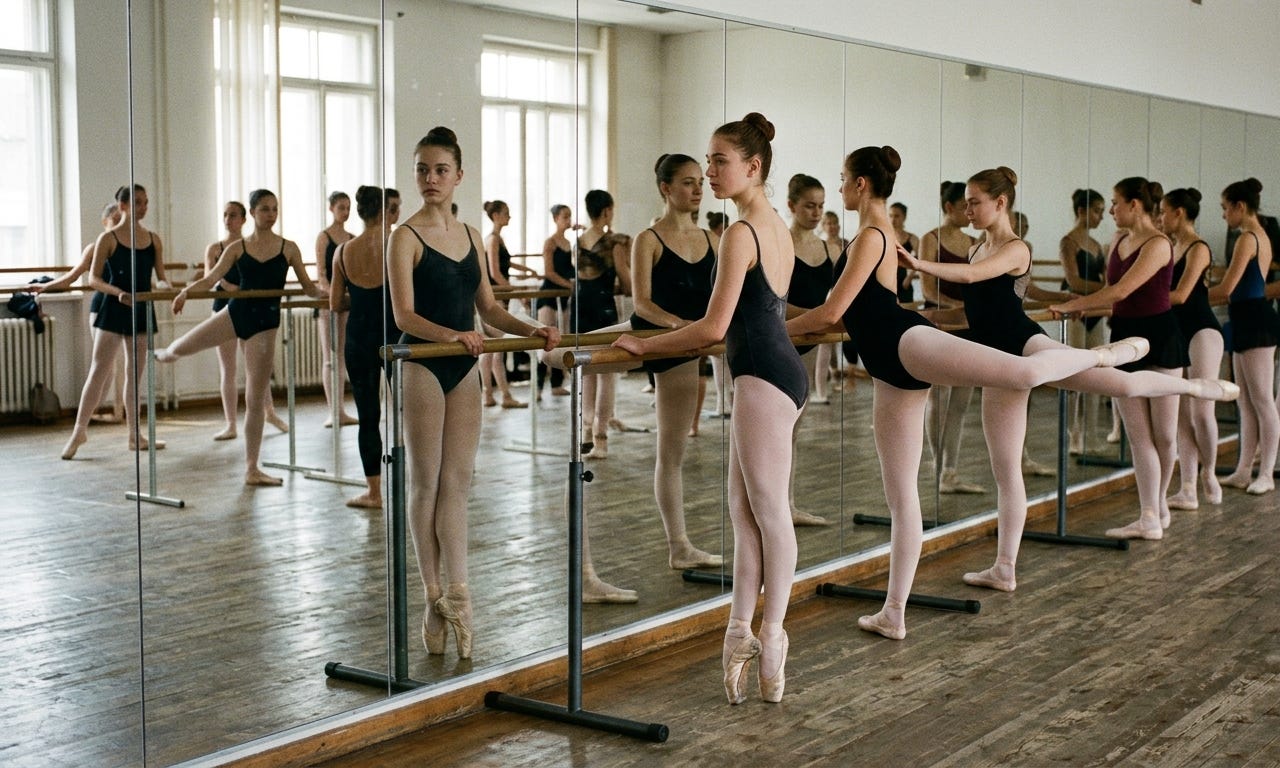
In a ballet studio, the front wall is a mirror. Floor to ceiling. Wall to wall. There’s nowhere to look that isn’t yourself.
To the outside eye it looks like a setup for comparison: 20 dancers lined up next to each other, every body visible to every other body. For the dancer who hasn’t learned how to use the mirror yet, that’s exactly what it becomes. A daily, hourly, full-length audit. Whose extension is higher. Whose turnout is cleaner. Whose feet are more arched. The mirror becomes the judge, the dancer becomes the defendant, and the class becomes a verdict that gets handed down every 90 minutes.
And then, one day, if she is lucky, a teacher tells her the truth.
The mirror isn’t there to show you the other dancers. The mirror is there to show you your own alignment.
That’s the entire shift. The dancer next to you isn’t your competition. Her hip has nothing to do with your hip. Her extension is not your extension. The mirror is a tool for one thing and one thing only: to show you whether your line is true. Whether your shoulders are over your hips. Whether your weight is centered. Whether you are, in your own body, in your own moment, in alignment with the work you came here to do.
A dancer who looks at the mirror and sees the other dancers will spend her career losing. A dancer who looks at the mirror and sees her own line will spend her career building.
Your phone is a mirror. You’ve been using it wrong.
The mirror isn’t there to show you the other dancers. The mirror is there to show you your own alignment.
The 90-second reset for the comparison spiral
There’s a piece of neuroscience that, once you know it, you’ll use for the rest of your life.
Harvard-trained neuroanatomist Jill Bolte Taylor (best known for her book My Stroke of Insight) has described what she calls the 90-second rule. When a strong emotion gets triggered in the brain, a cascade of stress chemicals floods the body. Cortisol. Adrenaline. The chest tightness, the racing pulse, the heat in the face. That chemical surge takes roughly 90 seconds to move through the body and clear, if you let it.
Everything that lasts longer than 90 seconds is your thinking feeding the loop. You replay the post. You imagine her life. You construct the story of what she has, and you don’t. The chemicals re-fire. The body stays on alert. Ninety seconds becomes 90 minutes becomes a Tuesday night you can’t get back.
Here’s the protocol. Five steps. 90 seconds. Use it the next time the spiral hits.
1. Name it. Out loud or in your head: “that’s the comparison spiral. That’s my amygdala. I’m not in danger.” Naming what is happening pulls the prefrontal cortex back online. You can’t reason your way out of a fight-or-flight response, but you can name your way back into your own driver’s seat.
2. Put the phone down. Face down. Out of arm’s reach. The single most important thing you can do for the next few seconds is not to give your brain new fuel for the loop.
3. Find your line. This is the ballet move. Stand up. Shoulders over hips. Feet planted, weight even. Crown of the head lifting. You’re not striking a pose. You’re giving your nervous system one clean piece of information: the body is here. The body is safe. The body has a line.
4. Take three slow breaths. Out longer than in. Four seconds in, eight seconds out, if you can. The long exhale is what tells your vagus nerve that the threat is over. The chest will start to soften. The shoulders will drop a fraction of an inch.
5. Ask the dancer’s question. Not “what does she have that I don’t.” Not “why am I behind.” One question, and only this one: what does my alignment look like right now? What is true for me, in my body, in my life, this Tuesday at 9:47 PM. Not what should be. Not what hers is. What mine actually is.
That’s the reset. 90 seconds. You can do it standing in your kitchen. You can do it in the parking lot before you walk into a school event. You can do it the next time the phone tries to convince you that you’re losing a race nobody is running.
One caveat: Taylor’s 90-second figure came from her own observations during stroke recovery, not a controlled trial. Treat it as a useful frame for how long a triggered emotion takes to clear when you stop feeding it, not a stopwatch.
The one-account rule
There’s also a structural move, and it’s smaller than you think.
This week, unfollow one account that makes you feel behind.
Not 10. Not your whole feed. One. The one you know. The one whose name came into your mind the second you read that sentence. The one whose post you saw last Tuesday at 9:47 PM.
And here’s the rule: don’t replace it with another account. Don’t curate a better one. The point isn’t to find a more inspiring person to compare yourself to. The point is to reclaim a single square inch of attention from the comparison engine and give it back to your own life.
Replace it with nothing. Let the space be empty. Notice what happens in the space.
Reply and tell us
If you’ve been scrolling at night and feeling something tighten in your chest or if you’ve been telling yourself you’re fine, you’re happy for her, you’re being ridiculous, while your nervous system runs on alarm then reply to this email or drop it in the comments.
Tell us the account you’re unfollowing this week. You don’t have to name names. Just tell us the category. The mom who has it together. The friend whose career took off. The cousin whose marriage looks easy. The woman whose body is the body you used to have.
Other women will read it. And it will help them name the one they’re carrying, too.
You’re not jealous. You’re not broken. You’re a woman with a 70,000-year-old brain trying to live a 21st-century life.
The mirror isn’t there to show you the other dancers. It’s there to show you your line.
— The Ballerina Hustler
Every neuroscience and psychology claim in this essay is sourced from peer-reviewed research and credited sources. For full citations, reply to this email. This essay is performance coaching, not medical advice or therapy; for clinical concerns, please consult a qualified healthcare provider.
Great article
I really loved this article! As a dance mom of a pre-professional dancer, I can honestly say she started improving the most when she found herself in the mirror. She’s found that success comes from a her vs her mentality. I also really LOVE that you used this concept to speak to a wider audience about comparing yourself to others! Such a great bridge and great writing!