


You can hold it together in front of everyone and still be falling apart.
That’s not a contradiction. It’s the most expensive thing you do all day.
You wake up tired. Not the kind of tired that sleep fixes. The kind where you’re already running on empty before your feet hit the floor, and you still walk out the door looking calm, capable, handled.
You answer, “I’m good!” before anyone finishes asking.
You hold the steady voice on the call.
You smile at pickup.
You’re the one who has it all together. Everyone says so.
And it’s quietly wrecking you.
• • •
Here’s the part nobody says out loud.
The performance of “fine” is what’s making it impossible to be fine.
Not your job. Not your kids. Not your inbox. The performance itself. The energy you spend looking okay is the exact energy you no longer have to be okay.
We’re going to show you why, and what professional dancers know about this that you were never taught.
What the mask actually costs
There’s a specific thing your body does when you hide what you feel. Researchers have a name for it: expressive suppression. It just means keeping the outside calm while the inside is anything but.
You’d think hiding it would help. Push the feeling down, get through the day, deal with it later.
Here’s what happens.
In a 1993 study, psychologists James Gross and Robert Levenson tested this directly. People who hid their emotions didn’t feel them any less. The feeling stayed exactly as strong. But their bodies worked harder than the people who hid nothing: heart rate up, blood pressure up, the stress system running in the background.
Read that twice.
Hiding it doesn’t lower the feeling. It just adds a second job on top of it: the job of hiding.
So, the mask isn’t free. It runs all day in the background, draining the battery while the screen looks calm.
And there’s a colder detail. When you suppress in front of other people, their bodies feel it, too. In a 2003 study, researcher Emily Butler and her team found that women who hid their feelings during a hard conversation drove up the blood pressure of the person sitting across from them, and the connection between them frayed. The mask doesn’t just cost you. It quietly taxes the people you’re wearing it for.
Why this lands harder on women
You weren’t born performing. You were trained.
Sociologist Arlie Hochschild gave this a name back in 1983: emotional labor. It’s the work of managing your face and your feelings so other people stay comfortable. She first studied it at work: flight attendants trained to stay warm and calm no matter what was happening inside them. And she documented who gets handed this job the most: women. We’re the ones expected to manage how everyone around us feels.
Hochschild also noticed there are two ways to wear a face you don’t feel. One is deep acting, which means working yourself into the feeling until it’s real. The other is surface acting, which means faking the outside while the inside stays exactly the same.
Researcher Alicia Grandey put these to the test. Across study after study, surface acting (the pure faking) is the one that burns people out. The gap between the calm face and the real feeling is what grinds you down to nothing. Deep acting doesn’t carry the same cost.
That gap has a price. And you’ve been paying it since you were a little girl who learned that being “easy” and “good” meant managing how everyone else felt about you.
This isn’t a flaw in you. It’s a pattern that got built into you. And patterns can be rebuilt.
The performance of “fine” is what’s making it impossible to be fine.
The skill you were never handed
Here’s what dancers know.
A professional dancer can walk onstage and become someone else completely. She can play the villain (cold, sharp, and frightening) for 20 minutes under the lights. Full presence. Nothing held back.
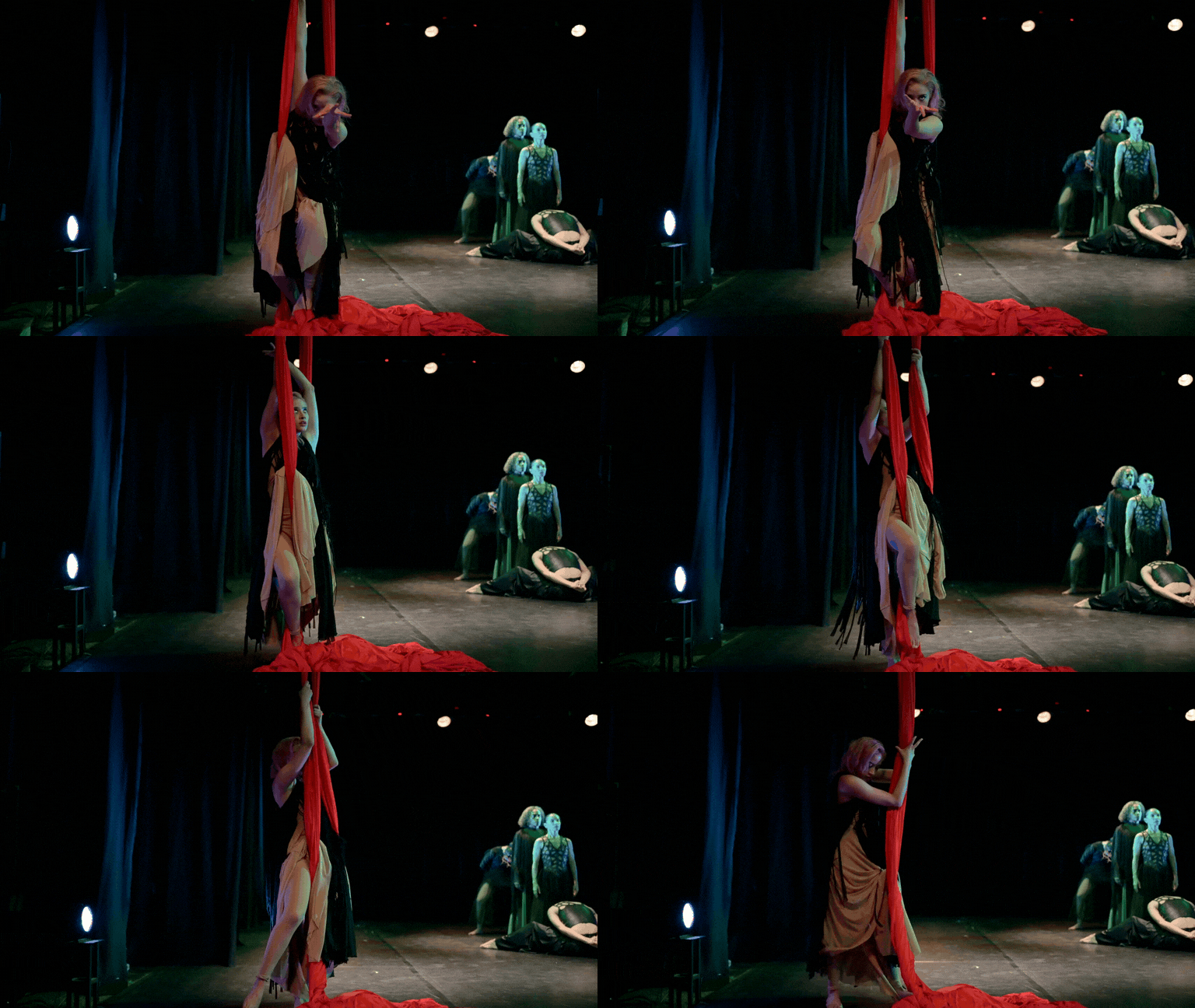
Then, she walks into the wings. And an hour later she’s reading her kid a bedtime story.
The villain was real on that stage. It was also a costume. She put it on, she gave it everything, and then she took it off.
That’s the skill. Not faking. Bounding. The performance has a start and a stop. The role is something she does, not something she is.
There are three places in a dancer’s night:
Onstage — full performance, everything projected outward.
The wings — the in-between, where the projection drops but she’s not done yet.
Backstage — costume off, no audience, just a person.
The dancer who keeps herself separate from the role can give everything on that stage and still have a self left over when the curtain drops.
The dancer who can’t is the one who becomes the role. And she’s the one who breaks when it ends.
• • •
Now here’s the hard truth about the “I’m fine” mask.
You’ve collapsed all three places into one. You’re onstage all day. You never reach the wings. You never get backstage. There’s nowhere the costume comes off.
That’s why taking the mask off feels like free fall. You’ve worn it so long it stopped feeling like a costume and started feeling like your face. Dropping it feels like disappearing.
You won’t disappear. You’ll finally get to put something down.
This week’s pivot
This week, all of it is yours. Free. The whole method is right below.
But starting next Tuesday, this is exactly where the page stops for free readers. Everything below the line, the part that does the work, becomes what paid subscribers get. The part that helps you spot the pattern in the first place stay free and open to everyone. The deep-dive protocol goes to those who want to do the work with us.
The Backstage: how to take the mask off without falling apart
You don’t fix this by ripping the mask off in front of everyone. That’s not brave. That’s just a different kind of crash.
You fix it the way dancers do. You build a backstage. A small, private place where you stop performing. Three steps. But first, one thing to figure out.
You can’t take off a costume you can’t name. Most women wear one of four. Read these and notice which one tightens your chest a little.
Unbothered. Nothing gets to you. You’re chill. You’re fine. (You’re not.)
Has-It-Handled. You’ve got it. You always have it. Asking for help isn’t a thing you do.
The Strong One. Everyone leans on you. You lean on no one. If you crack, who holds it all?
The Easy One. Low-maintenance. No trouble. You shrink so nobody has to manage you.
Pick the one that stung. That’s your mask. Say it out loud: “Right now I’m playing The Strong One.”
Naming it does one quiet, powerful thing. It reminds you the costume is a costume. You’re the person wearing it. Not the costume itself.
• • •
Now the three steps.
Step 1: NAME the role you’re playing.
Not “I’m a mess.” Not “I’m so behind.” That keeps you stuck inside the feeling.
Name the performance instead. “Right now, I’m playing Unbothered.” “I’m playing Has-It-Handled.” “I’m playing The Strong One.”
Step 2: WINGS. Find yours.
One spot. Every day. Ninety seconds where you let the face drop and perform for no one.
The car in the driveway before you walk in. The bathroom with the door shut. The walk from the train. You’re not fixing anything. You’re not solving the day. You’re just not on for 90 seconds.
This is where you let the feeling move instead of pushing it down. Remember the science: pushing it down costs more. Letting it surface, even for a minute and a half, costs less.
Step 3: BACKSTAGE. One honest sentence. Written. Unshared.
Once a day, or even once a week, write down one true thing. For no audience. No one reads it.
“I’m not fine about ___.”
That’s it. You’re not fixing it. You’re not posting it. You’re just ending the one performance that costs the most. The one where you pretend to yourself.
The page is your backstage. It’s the one place the costume comes all the way off.
Three steps: Name. Wings. Backstage.
What this looks like in real life
Take Maya. Not her real name. Could be yours.
She’s the one everyone calls when it falls apart. Mask: The Strong One. By Thursday she’s snapping at her kids, her partner, and her team. She can’t figure out why, because “nothing’s even wrong.”
So, she tries it. In the car after work, she names it: “I’m playing The Strong One.” Face dropped, nobody watching, 90 seconds. Then one sentence in her phone: “I’m not fine about carrying this by myself.”
Nothing on the outside changed. Her week was still hard. But the snapping stopped. Because she wasn’t spending Thursday’s energy hiding Thursday’s truth from herself.
That’s the whole mechanism. You don’t get more hours. You stop paying the hiding tax.
One thing that trips people up
Don’t try to take the mask off in front of everyone at once. That’s not honesty. That’s a crash, and your body knows the difference.
Backstage is private on purpose. You’re not swapping the performance of strength for a new performance of falling apart. You’re building one room where you’re not performing at all. Start there. The rest follows.
Because the goal was never to perform “fine” well enough that you finally feel it. That performance has no curtain call. It runs until you run out.
The goal is to give yourself a place where the mask comes off. A backstage. So, you’re still there when the lights go down.
This Friday: Your Weekly Debrief
The Weekly Performance Debrief ran through September 2026. That practice now lives in the monthly NEPP Protocol.
Before you go, watch your inbox this Friday. We’re sending the Weekly Performance Debrief: a short, guided ritual that takes what you just read and runs your real week through it. Where did you perform “fine”? What did it cost? What’s one thing you’ll do differently? You close your week in five to 10 minutes, then you put it down. It’s free this week, so you can feel exactly what Fridays become. Don’t let it sit unopened.
— The Ballerina Hustler
Every physiological and neuroscience claim in this essay is sourced from peer-reviewed research and credited sources. For full citations, reply to this email. This essay is performance coaching, not medical advice or therapy; for clinical concerns, please consult a qualified healthcare provider.
Sandra, this was really good. The distinction you make between performing when you need to and never really getting to stop is a good one. I’ve spent a lot of years being the guy who could hold it together when I needed to. The harder part is knowing when “when I need to” is over.
Yes! Great post… I wrote something similar in the spring: https://substack.com/@writingwewriterswriteright/note/c-243228900?r=5sixgt&utm_medium=ios&utm_source=notes-share-action