

Barre note: The middle isn’t a wall. It’s where the work starts to show.
5 6 7 8
Happy Tuesday!
Welcome to Issue #032. This one is for anyone who sits in the car after class, wondering why it isn’t getting easier. You belong here. 💕
New here? Every Tuesday we bring you one idea from neuroscience, embodiment, psychology or ballet, one thing to try the same day, and the study linked so you can check our work. It’s for women who dance, danced, or always wanted to, and who carry a lot: in the studio, at work, in your business and at home. You don’t need to have danced a step for any of this to work.
Today’s counts
The Lead: why the middle feels slow, and five things that help.
Center: “She started after me.”
Embodied: a five-minute balance check you can track.
From the Barre: shaking first pliés.
Ballet word of the day: Sur le cou-de-pied
“On the cou-de-pied.” One foot rests on your standing leg “between the base of the calf and the beginning of the ankle,” in American Ballet Theatre’s words.
Pirouette puzzle: My name means “developed.” I unfold slowly and hold still at the end. What am I? (Answer in Curtain Call.)
Brain Notes
The research behind today’s issue, straight from the source:
◆ Kindness keeps you working. Four 2012 experiments at UC Berkeley on self-compassion after failure. Read the abstract
◆ Write it down. A 2016 review of 138 studies on tracking your progress. Read the review
◆ Missed last week? Read past issues
THE LEAD · PSYCHOLOGY
Why Do I Feel Stuck in Ballet? How to Get Through the In-Between Level

It’s 8:40 PM in the studio parking lot. Your hair is damp at the neck, your calves still buzz, the heater is ticking, and you haven’t started the car. You fell out of the pirouette again. The woman next to you didn’t.
You’ve outgrown Beginner. Intermediate feels like a wall. So you sit in the car after class and wonder if you started too late. You didn’t. You’re in the in-between level, and here’s what helps.
1. Know the gap is wide.
San Francisco Ballet School describes its adult Beginner class as “for adults who are new to ballet or have taken ballet classes for less than two years.” Its Intermediate class asks you to “have an in-depth knowledge of ballet terminology and be proficient with center work.” (SF Ballet)
That’s a road measured in years. At one class a week, two years is about 100 classes, which isn’t many for a whole new language of movement. Center work means dancing in the middle of the room, with no barre to hold on to. Slow in the middle is what the middle looks like.
2. Change the voice in the car.
Many of us believe being hard on ourselves keeps us working. In 2012, two psychologists at UC Berkeley, Juliana Breines and Serena Chen, tested that idea in four experiments. In one, people who failed a hard test and were then guided toward self-compassion “spent more time studying for a difficult test following an initial failure” than people in the comparison groups. (Breines and Chen)
The authors wrote that, “somewhat paradoxically,” accepting a failure “may make people more motivated to improve themselves.” Going easier on yourself was linked to more effort. These were short lab tasks with volunteers, not dancers. Still, next time the car voice says “You’ll never get this,” try what you’d tell a friend: “This is hard, and you came anyway.”
3. Name one stuck spot.
“I’m not getting better” is too big to work on. Is it turns? Balance? Remembering combinations? Pick one. Why one? A class already asks you to remember the steps, the music and your feet. One target is something you can hold. A small, named target gives you something to aim at, and you’ll notice when it moves. Big goals hide progress. A small one shows it: last month you wobbled on both sides, this month only on the left.
4. Write it down.
This is the step most of us skip. A 2016 review led by researchers at the University of Sheffield pooled 138 studies with 19,951 people. Helping people check their progress “promoted goal attainment,” and it worked better “when the outcomes were reported or made public, and when the information was physically recorded.” (Harkin et al.)
None of those studies were about ballet. But a two-minute note after class shows you what memory hides. Writing also turns a feeling (”I’m hopeless”) into a fact you can check (”three wobbles, down from five”). You are moving, just slowly. The Bonus log helps.
5. Ask one question before you leave.
Your teacher can’t hear what you’re thinking in the car, but they can see you from the outside, which you can’t. Next class, stay one minute and ask: “What’s one thing I could work on to get ready for the next level?” A real answer beats a guess. Write it down after class, so your progress is on paper.
Try this today
Write your one stuck spot on a card or in your phone.
Under it, write one thing that went better this week, however small.
Plan your one question for next class.
Carry it over
At work: keep a “done” list for the project that feels stalled.
In your business: track one number for eight weeks before you judge it.
At home: say the kind version out loud, the one you’d say to a friend.
Key takeaways
Beginner to Intermediate takes years. Slow isn’t stuck.
Self-compassion after a setback is linked to more effort, not less.
Write your progress down. Tracking on paper is linked to reaching more goals.
CENTER · PSYCHOLOGY
“She started after me.”
A woman who joined after you lands a clean double. You don’t know her road: maybe years of ballet as a girl, maybe three classes a week.
Your exercise: two roads (60 seconds)
Write her name and “her road.” Below, write your name and one thing you can do now that you couldn’t do in the spring.
EMBODIED
Your five-minute balance check
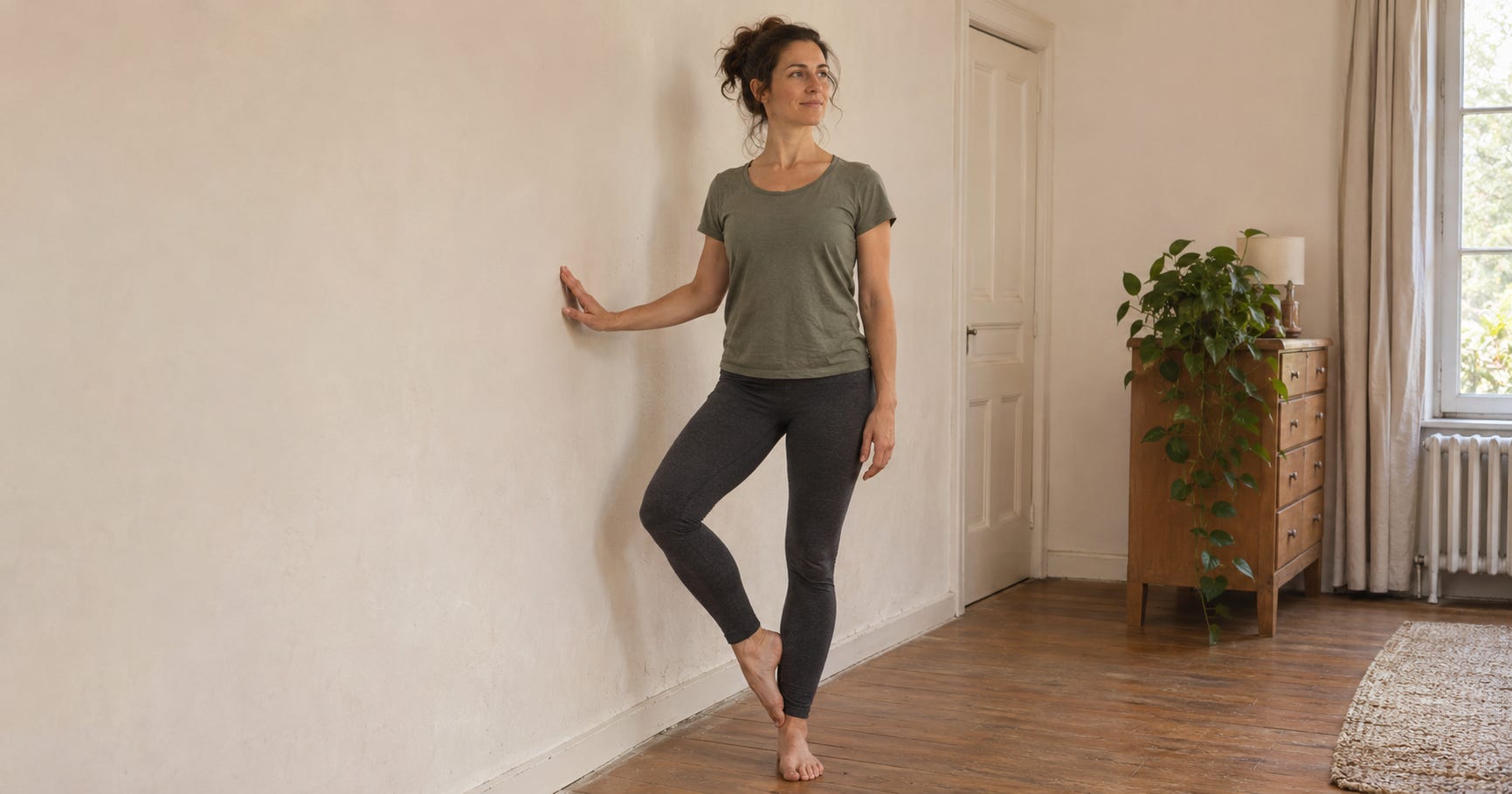
Five minutes for your body + brain, beside a wall.
Set up (one minute). Stand side-on to a wall, fingertips resting on it.
Find the spot. Lift your outside foot to sur le cou-de-pied, resting just above the ankle bone of your standing leg.
Count (two minutes). Float your fingertips a breath away from the wall. Count slowly until you need it again. Do it three times.
Switch sides (one minute). Turn around and repeat.
Write it (one minute). Your best count on each side, and the date.
Touching the wall is part of the practice. Keep it gentle. Stop if anything hurts or you feel dizzy, and check with your doctor or physical therapist first if balance needs extra care.
Ballet-Inspired Principle of the Week
Développé.
American Ballet Theatre calls développé a “developing movement”: the working leg is “drawn up to the knee of the supporting leg and slowly extended to an open position en l’air and held there with perfect control.” (ABT Ballet Dictionary)
For a moment the leg is neither folded nor open. It’s unfolding, and that slow part is what makes the finish steady. The in-between level is that moment. You aren’t stalled.
This week: when you feel stuck, say “I’m still unfolding,” then write one thing that moved. More ballet-inspired principles →
From the Barre
Frances Solá-Santiago came back after more than four years away. In Pointe in 2020, she wrote that her first pliés “made my legs tremble so hard that my bedroom dresser started shaking.” A few weeks later, “I started taking an intermediate class instead of basic.” (Pointe)
Shaking is part of it.
Quick answers
Why do I feel stuck in adult ballet?
You may feel stuck because adult levels are far apart. At San Francisco Ballet School, adult Beginner is for less than two years of ballet, and Intermediate expects “an in-depth knowledge of ballet terminology.” Two years at one class a week is about 100 classes. Slow isn’t stuck.
Does self-compassion help you improve?
Self-compassion may help you keep working. In one of four 2012 UC Berkeley experiments, people guided toward self-compassion after failing a hard test studied longer for the next one. These were short lab tasks with volunteers, not dancers. Try what you’d tell a friend: “This is hard, and you came anyway.”
What is a développé in ballet?
A développé is a slow unfolding of the leg. American Ballet Theatre says the working leg is “drawn up to the knee of the supporting leg and slowly extended to an open position en l’air and held there with perfect control.”
Road to Nutcracker · Butterflies? Call them excitement.

Every December, theaters everywhere fill up for The Nutcracker. For many dancers, it’s the biggest show of the year. You don’t need to dance to feel what comes before it: the nerves, the practice, and the big moment when it’s your turn. That’s what the Road to Nutcracker is about. Every Tuesday through December 15, we take one part of a dancer’s run-up to the show and turn it into a small tool you can use before your own big moment. That could be a class, a meeting, a hard talk or a first try at something new. Dancer or not, this is your season, too.
Feeling stuck in the in-between can bring butterflies, too. That flutter before class, or before you try the step you keep avoiding, is not a sign you are behind. Nerves and excitement feel a lot alike in the body. Both raise your heart rate and wake you up. In a 2014 Harvard study, people who told themselves “I’m excited” before a hard task did better than people who tried to calm down. This week, try telling yourself “I’m excited” instead of “I’m nervous,” and see what changes.
Want a little help on the Road to Nutcracker? Save your seat and Wings Card 0 is yours: this week’s line on a ticket card and a phone wallpaper. Save your seat
Curtain Call
Your story could go here. Made it through a plateau? Tell us, and we may share it with your OK. Send us your story →
This week’s ballet to watch: In the Royal Ballet’s glossary clip, watch the développé’s slow middle. (Royal Ballet and Opera)
Pirouette puzzle answer: développé. See why →
Coming soon: PRIMA
We’re building PRIMA, an AI companion for performance and life’s big moments, and a guided reflection practice. It’s an AI companion, not therapy. Waitlist members get first access. Join the PRIMA waitlist →
Hit reply and tell us what landed. We read every note.
See you at the barre,
The Ballerina Hustler team
P.S. Know someone who feels stuck? Forward this. She can subscribe here.
Ballerina Hustler™ is a weekly newsletter on neuroscience, embodiment, psychology and ballet-inspired principles. This is education, not medical advice, diagnosis or therapy. For clinical concerns, please see a qualified healthcare provider. If you’re in crisis in the United States, call or text 988.
Sources cited in this issue
Breines JG, Chen S (2012). Self-compassion increases self-improvement motivation. Personality and Social Psychology Bulletin.
Harkin B et al. (2016). Does monitoring goal progress promote goal attainment? Psychological Bulletin.
San Francisco Ballet School. Adult drop-in classes.
Solá-Santiago F (2020). How coming back to ballet after years away has saved me during the pandemic shutdown. Pointe.
American Ballet Theatre. Ballet Dictionary.
Brooks AW (2014). Get excited: reappraising pre-performance anxiety as excitement. Journal of Experimental Psychology: General.
Bonus: The Progress Log
Eight weeks, one entry per class.
Each week:
Date:
My stuck spot: (same one all eight weeks)
Balance count: right ___ · left ___
One thing that went better:
Kind sentence to myself:
At week 8: compare week 1 with week 8. If your stuck spot hasn’t moved, show your teacher and ask what to try next.