

Barre note: Write it down. Your tired brain will skip a step your card won’t.
5 6 7 8
Happy Tuesday!
Welcome to Issue #034, for every woman making hard calls on an empty tank. Thanksgiving week means more to carry. 💕
New here? Every Tuesday we bring you one idea from neuroscience, embodiment, psychology or ballet, one thing to try the same day, and the study linked so you can check our work. It’s for women who dance, danced, or always wanted to, and who carry a lot: in the studio, at work, in your business and at home. You don’t need to have danced a step for any of this to work.
Today’s counts
The Lead: why tired judgment slips, and four questions that catch it.
Center: the “keep going” voice.
Embodied: Five-minute check before a hard call.
From the Barre: a surgeon who danced, on listening.
Ballet word of the day: Sur les pointes
“On the points,” in American Ballet Theatre’s words: “The raising of the body on the tips of the toes.”
Pirouette puzzle: I’m “on one leg what a plié is on two,” and I help you land softly. What am I? (Answer in Curtain Call.)
Brain Notes
The research behind today’s issue, straight from the source:
◆ Two ways to fix a biased decision. A 2025 review of 100 experiments. Read the paper
◆ What cognitive bias is. A Cleveland Clinic psychologist explains. Read the article
◆ Missed last week? Read last week’s issue
THE LEAD · PSYCHOLOGY
Why Your Judgment Fails When You’re Depleted (And the 4 Questions That Catch It)
Self-awareness costs energy. Here’s what to do when you don’t have any.
Self-awareness is a luxury good.
And it’s being sold, hard, to people who cannot afford it.
Every piece of advice you’ve ever been handed about making better decisions assumes you have something left to spend. Attention. Room. A quiet minute to catch yourself in the act.
That advice was written for a rested person. You’re not currently that person.
The call you made too fast
Think about the last hard call you got wrong.
Someone described the problem to you first. A client, a boss, your mother. They said something like, “She’s just not motivated.”
And you built everything after that on top of their sentence.
Weeks later the real problem surfaced. It was that two people had the same job and neither one knew it.
You didn’t miss that because you’re careless. You missed it because the first sentence you heard set the shape of the room, and rearranging a room costs energy.
What is running in your head
A heuristic is a shortcut. A bias is what happens when the shortcut misses. Amos Tversky and Daniel Kahneman named this pattern in 1974.
None of this is a defect. As Dr. Kia-Rai Prewitt of the Cleveland Clinic puts it, we interpret information through our own beliefs and experiences, and sometimes that interpretation isn’t accurate.
The correction you were never given
In a ballet class, the teacher doesn’t correct the thing that hurts. Your wrist is doing something strange. She tells you your standing leg has quit, and your wrist is only where you’re paying for it.
That’s what a correction is. Almost none of us get one at work, at home, or in the middle of a hard decision.
Here is the part nobody says out loud
In 2025, Barbara Fasolo, Claire Heard and Irene Scopelliti published a review in the Journal of Management that pulled together 100 experiments on fixing biased decisions. They found two roads.
The first is debiasing. You work on the person.
The second is choice architecture. You change the room, so the better answer is the easier answer.
Debiasing runs on slack. It needs time and attention. When someone faces severe limits on both, its effectiveness may be compromised, and changing the environment may work better.
Read that again as a woman who’s holding everything together. When the tank is empty, stop asking more of yourself. Set things up so the right choice is the easy one.
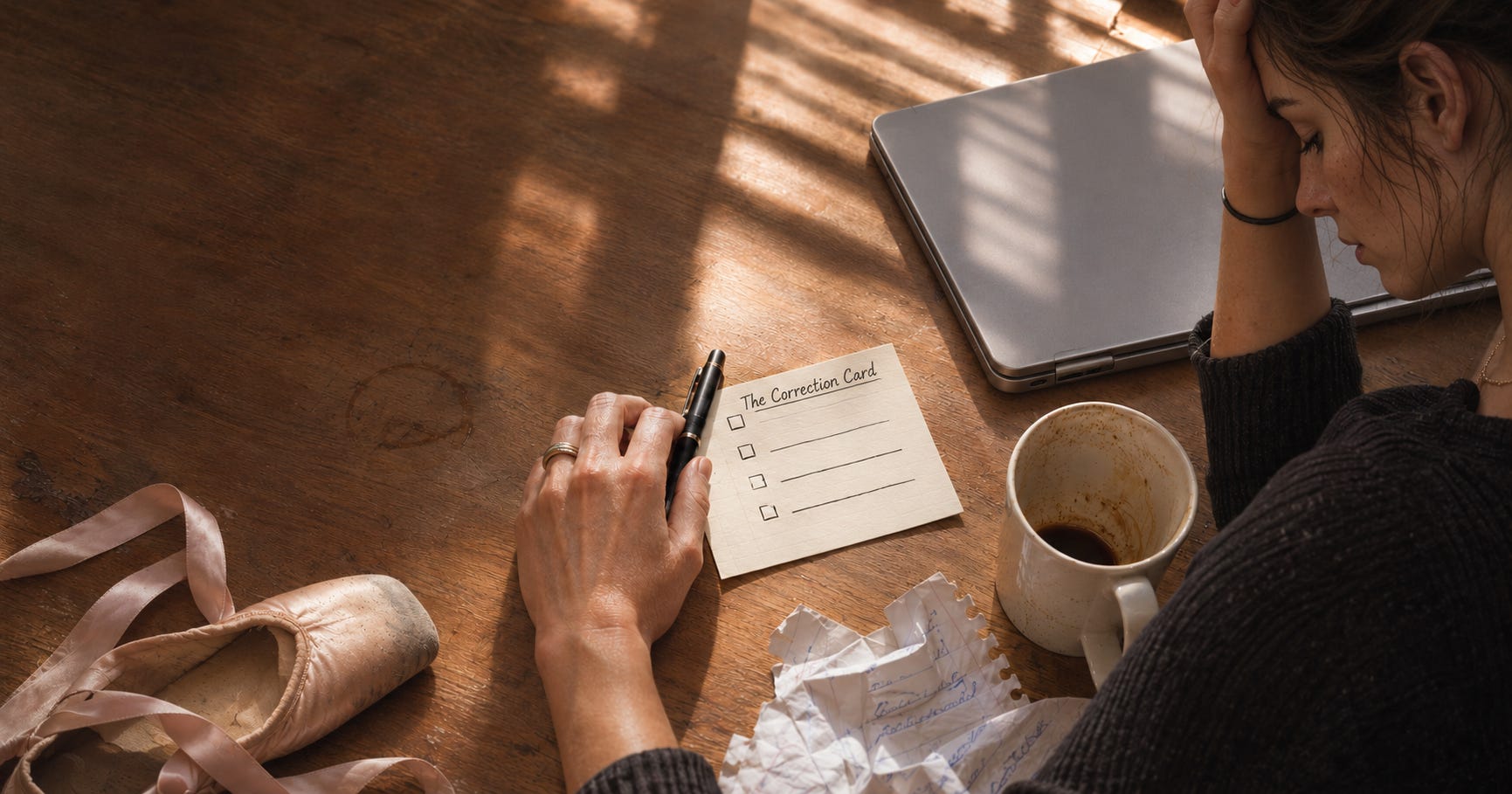
The Correction Card
Four questions. Ask them before the decision, written down, not in your head. Ninety seconds.
1. Whose sentence am I working from?
Write down the first framing you heard. Word for word. Then write two reasons it could be wrong.
Not “stay open-minded.” Two reasons. Written.
That number isn’t arbitrary. When Rosanna Nagtegaal and her colleagues tested this in 2020 on 1,221 managers and employees in the United Kingdom, the thing that moved the needle was specifically asking people to give two reasons the starting figure was inappropriate. It worked in goal-setting and in performance feedback, the two places this costs you most.
2. What would have to be true for me to be wrong?
Not “am I sure?” You’re always sure. That’s the whole trouble.
Instead, describe the world in which your read is incorrect. What would you be seeing? Who would be behaving differently? What evidence would exist that you have not gone looking for?
Then, go find one piece of it.
3. Have I seen this before, or does it just rhyme?
Your experience is real and it’s valuable. It’s also the fastest road to a wrong answer, because a case that resembles an old case gets treated like the old case before you’ve finished looking at the new one.
So, name one specific way this is different. One. Out loud or on paper.
Same symptom, different cause, is the most expensive mistake in this whole category. Work that keeps slipping can come from broken handoffs. Or unclear decision rights. Or too few people. Or nobody having the tool they need. Or a manager who won’t say the hard thing. Identical symptom. Five different fixes.
4. Is this a person problem or a situation problem?
If your read blames somebody’s character, stop.
Name one thing about the setup, the workload, the timeline, the information they had, that would produce the exact same behavior in a person you deeply respect.
If you can find one, you were probably looking at a situation and calling it a personality.
Where the card lives
A card in your head isn’t a card. Put it where the decision happens. You’re building a room where the thinking happens by default.
You didn’t get worse at your job, your marriage, or your judgment. You got depleted. So move the check outside your head, and give yourself the correction that nobody else is standing there to give you.
Try this today
Write the four questions on one card.
Put it where your next hard call happens.
Run it before you decide, not after.
Carry it over
At work: top of your meeting agenda.
In your business: pinned note in the client file.
At home: taped inside the notebook you carry.
Key takeaways
Checking your own thinking costs energy.
Short on time and attention? Change the setup, not yourself.
Ask four questions, on paper, before any hard call.
Save this one. Then, send it to the woman you thought of while you were reading it. That’s how we find each other.
CENTER · PSYCHOLOGY
The “keep going” voice
You’re tired. Everyone else looks fine. So a voice says: don’t make a fuss, keep going.
It means well. It doesn’t know what you have left.
Your exercise: the friend test (60 seconds)
Write what you’d tell your best friend if she were this tired and facing your call. Then, read it as if it were written to you.
EMBODIED
Your five-minute check before a hard call
Five minutes for your body + brain, before the call or tonight.
Arrive (one minute). Sit, feet flat. Let your breath slow on its own.
Where (one minute). Find where you hold the day. Point to it.
What kind (one minute). Pick one word: tight, heavy, buzzing, flat, calm.
How full (one minute). Rested, or running low? Be honest.
Write it (one minute). Spot, word, how full, and the call you face.
Running low? Run the Correction Card from the Lead before you decide.
Ballet-Inspired Principle of the Week
Video: “Beginner Ballet Basics fondu” by Holistic Ballet on YouTube.
Fondu.
American Ballet Theatre defines fondu as “Sinking down,” a “lowering of the body made by bending the knee of the supporting leg.” It quotes the old ballet master Saint-Léon: “Fondu is on one leg what a plié is on two.” (ABT Ballet Dictionary)
A fondu goes down on purpose: you lower slowly, feeling every inch. Off stage, that’s listening.
This week: when a hard call comes up, slow down and name whose sentence you’re working from. Then push on. More ballet-inspired principles →
From the Barre
Yale orthopaedic surgeon Arianna Gianakos, a one-time ballet dancer, told Yale News in 2025: “Knowing your body and listening to your body is important. That’s a good first step. Seeing a physician is also important.” (Yale News)
Quick answers
Why do I make worse decisions when I’m tired?
Checking your own thinking takes time and attention. A 2025 review of 100 experiments in the Journal of Management says training people out of bias needs both. When both are scarce, training may work less well, and changing the setup around the decision may work better.
What is cognitive bias?
A cognitive bias is what happens when a mental shortcut misses. Amos Tversky and Daniel Kahneman described these shortcuts in 1974. Cleveland Clinic psychologist Kia-Rai Prewitt says we may interpret information based on our own beliefs and experiences, and that may or may not be accurate.
How can I check my thinking before a big decision?
Ask four questions on paper before you decide: Whose sentence am I working from? What would have to be true for me to be wrong? Have I seen this before, or does it just rhyme? Is this a person problem or a situation problem? Keep them where you decide.
Curtain Call
Your story could go here. Caught a hard call before you made it? Tell us, and we may share it with your OK. Send us your story →
Pirouette puzzle answer: fondu. See why →
Hit reply and tell us what landed. We read every note.
See you at the barre,
The Ballerina Hustler team
P.S. Know someone running on empty? Forward this. She can subscribe here.
Ballerina Hustler™ is a weekly newsletter on neuroscience, embodiment, psychology and ballet-inspired principles. This is education, not medical advice, diagnosis or therapy. For clinical concerns, please see a qualified healthcare provider. If you’re in crisis in the United States, call or text 988.
Sources cited in this issue
Tversky A, Kahneman D (1974). Judgment under uncertainty: Heuristics and biases. Science, 185(4157), 1124 to 1131. DOI 10.1126/science.185.4157.1124.
Fasolo B, Heard C, Scopelliti I (2025). Mitigating cognitive bias to improve organizational decisions: An integrative review, framework, and research agenda. Journal of Management, 51(6), 2182 to 2211. DOI 10.1177/01492063241287188.
Nagtegaal R, Tummers L, Noordegraaf M, Bekkers V (2020). Designing to debias: Measuring and reducing public managers’ anchoring bias. Public Administration Review. DOI 10.1111/puar.13211.
Cleveland Clinic (2023). Cognitive bias 101: What it is and how to overcome it, with psychologist Kia-Rai Prewitt, PhD. Health Essentials.
Dalton M (2025). The power of a dancer’s ankle. Yale News.
American Ballet Theatre. Ballet Dictionary.
Bonus: The 10-Minute Weekly Debrief
Once a week, 10 minutes. Pull up the calls you made. For each one, answer two questions:
The call
Which of the four questions would have caught this, if any?
What did I actually find out later?
Write the answers down. That’s it.
We all need reminding to be extra vigilant when we are tired.
You have such good content.