

Barre note: The right class is the one that stretches you without losing you.
5 6 7 8
Happy Tuesday!
Welcome to Issue #033, for anyone who has stared at a class schedule, unsure which door is hers. 💕
New here? Every Tuesday we bring you one idea from neuroscience, embodiment, psychology or ballet, one thing to try the same day, and the study linked so you can check our work. It’s for women who dance, danced, or always wanted to, and who carry a lot: in the studio, at work, in your business and at home. You don’t need to have danced a step for any of this to work.
Today’s counts
The Lead: how to read a class schedule.
Center: “I’ll be the worst one there.”
Embodied: a five-minute seated port de bras.
From the Barre: an adult’s first class back.
Ballet word of the day: Port de bras
“Carriage of the arms,” says American Ballet Theatre. Your arms float; your shoulders stay low.
Pirouette puzzle: You hold me first, then leave me for the middle of the room. What am I? (Answer in Curtain Call.)
Brain Notes
The research behind today’s issue, straight from the source:
◆ Relearning is often faster. A 2023 Harvard paper. Read the study
◆ The right level may help you learn. A 2004 framework. Read the abstract
◆ Missed last week? Read last week’s issue
THE LEAD · NEUROSCIENCE
Which Class Is Mine? How to Find Your Level as an Adult

It’s 9:15 on a Sunday night. Your tea has gone cold, and three studio tabs are open on your laptop. All three say “Beginner.” None of them mean the same thing.
Here’s the short answer: level names aren’t standard, so choose a class by fit, not by its label. And if you danced before, your body may pick things back up faster than you expect.
1. Know that the labels don’t match.
At Pacific Northwest Ballet School in Seattle, Beginner is for people who “have taken at least one year of ballet, danced in their youth, or have completed the PNB Fundamentals program.” (PNB) At San Francisco Ballet School, Beginner is “for adults who are new to ballet or have taken ballet classes for less than two years.” (SF Ballet)
Same word, different rooms. Neither is wrong. Each school sets its own ladder, so the name alone can’t tell you where you’d fit.
2. Read the description, not the name.
The description tells you who the class is really for. PNB says its Fundamentals of Ballet I “is designed for absolute beginners,” and tells newcomers, “If you have never taken a dance class before, we recommend starting with one of our eight- or nine-week fundamentals series.” (PNB)
Look for three things: who it’s for, what experience it expects, and how long it runs. Those three lines tell you more than the level name, because they describe the people in the room. If a description is vague, that’s your cue to ask.
3. Know your body may remember.
A 2023 Harvard paper on motor learning opens with a well-known idea: “Memories are easier to relearn than learn from scratch.” Scientists call this “savings.” In the team’s own reaching tests on a tablet, the quick relearning came from short-lived learning, not lasting memory. In other words, a fast start back is real, but it isn’t the whole story. (Hadjiosif, Morehead and Smith)
It was a short lab task, not years away from ballet, so no one can promise how fast your pliés come back. Still, if you danced before, give a level a few classes before you judge it. Judge the third class, not the first.
4. Choose the class that fits, not the bravest name.
In 2004, motor-learning researchers Mark Guadagnoli and Timothy Lee proposed that learning works best when a task’s difficulty matches the learner’s skill. Too easy, and there’s little to learn. Too hard, and it’s tough to take anything in. It’s a framework, not one experiment. (Guadagnoli and Lee)
Here’s a rule of thumb (ours, not a finding): can you follow most of each combination, most of the time? If yes, you’re in a good room, even if parts feel hard. If you’re lost in nearly every exercise, step down a level. That’s choosing the room where you can learn.
5. Ask the studio, then try one class.
Why ask before you book? A first class costs time and nerve, and an email costs neither. Before you book, send three questions:
“Is this a social class or a serious class?”
“What should a new adult be able to do before this class?”
“Can I try one class first?”
A clear, friendly answer is a good sign that newcomers are expected there. A slow or vague one tells you something too. One class will tell you more than any schedule can.
Try this today
Pull up one studio schedule near you.
Read the class description, not just the level name.
Send the studio the three questions above.
Carry it over
At work: pick the course or mentor that fits where you are now.
In your business: pick the small workshop that fits your stage.
At home: help your daughter or your mother choose her first class.
Key takeaways
Level names aren’t standard. Read the description.
If you danced before, your body may relearn faster. Give it a few classes.
Ask the studio three questions, then try one class.
Find your class on The Barre. Look for an adult class near you that’s friendly to true beginners or returners.
CENTER · PSYCHOLOGY
“I’ll be the worst one there”
The night before a new class, a voice says everyone there knows more than you. That’s a guess about a room you haven’t seen.
Your exercise: guess vs. plan (60 seconds)
Write the guess. Under it, write one thing you’ll do in the first 10 minutes.
EMBODIED
Your Five-Minute Seated Port de Bras
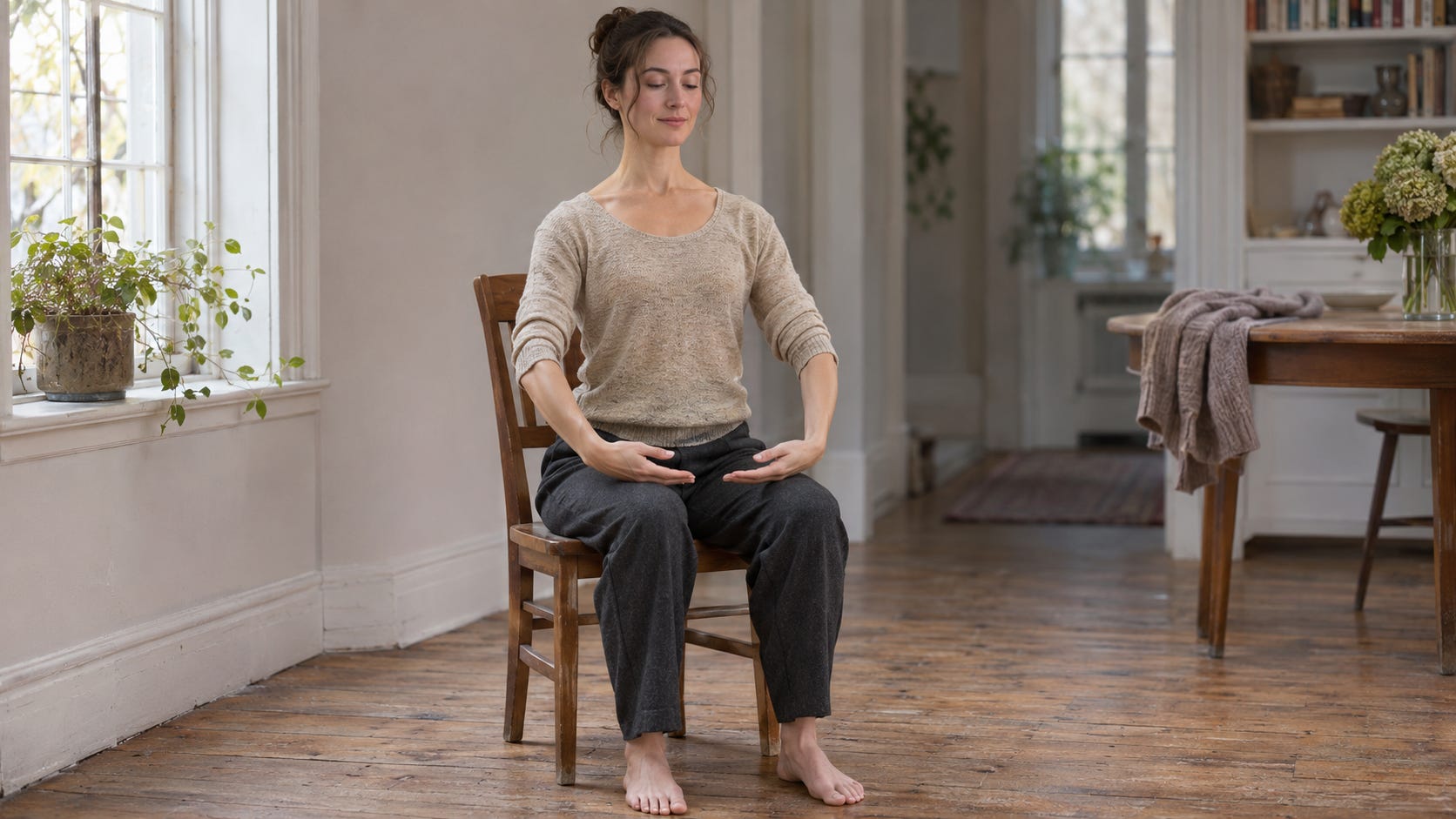
Five minutes for your body + brain, in a sturdy chair. Port de bras means “Carriage of the arms.” (ABT) Only your arms move. Shoulders down, neck long. Breathe slowly.
Bras bas. Sit tall, feet flat. Arms low and rounded, hands floating just in front of your thighs, not touching them. Breathe in for four counts, out for four. Five times.
First position. Breathe in as your rounded arms float up in front, to about rib height. Breathe out as they lower. Four times.
Second position. Breathe in to first. Breathe out as your arms open to the sides, a little below your shoulders. Lower. Four times.
Fifth position. Breathe in as your arms rise through first to overhead, hands just in front of your forehead. Breathe out as they lower. Four times.
Notice. What felt familiar? What felt new? Bring that to class.
Keep it gentle. Never hold your breath. Stop if anything hurts or you feel dizzy, and check with your doctor or physical therapist first if your shoulders, neck or balance need extra care.
Ballet-Inspired Principle of the Week
Barre, then center.
In class: They “start class at the barre.” It “is used as a support for the dancer and is held lightly.” Then they “move on to work in the centre of the studio.” (The Royal Ballet School)
Off stage: Your barre is the help you lean on while you rebuild. Going back to work after years at home, you might take a short course, ask a friend to look over your resume, or keep a list of new terms on your desk. Using that help doesn’t mean you’re behind. It’s what gets you to the day you can walk in alone and know what to do.
This week: Where’s your barre this week, and what’s one thing you can try without it? More ballet-inspired principles →
From the Barre
In a February 2025 essay for The Guardian, Eloise Skinner wrote that she went back to a beginner ballet class in her early twenties, after dancing as a child. “I was amazed to find that I remembered some of the patterns,” she wrote. (The Guardian)
Quick answers
What level of ballet am I as an adult?
Read the class description, not the level name, because levels aren’t standard. At Pacific Northwest Ballet School, Beginner expects at least a year of ballet. At San Francisco Ballet School, it welcomes new adults. Look for who it’s for, the experience it expects and how long it runs.
Is ballet easier to relearn if you danced as a kid?
Relearning may come faster than learning from scratch. A 2023 Harvard paper opens with a well-known idea: “Memories are easier to relearn than learn from scratch.” Its own tests used a short reaching task on a tablet, not ballet. Give it a few classes.
Why does ballet class start at the barre?
Ballet class starts at the barre, then moves to center. The Royal Ballet School says the barre “is used as a support for the dancer and is held lightly.” Then dancers “move on to work in the centre of the studio.”
Road to Nutcracker · Sleep before a big rehearsal.
The Nutcracker fills theaters every December. Through December 15, each Tuesday takes one part of a dancer’s path to the stage and turns it into a small tool you can use before your own big moment. You don’t have to dance for this season to be yours.
Late rehearsals, or the night before a new class, can leave the steps looping in your head. Sleep is part of the rehearsal. In a 2002 Harvard study, people were noticeably faster on a finger-tapping sequence after a night of sleep, while the same hours awake brought no real gain. This was a finger task, not dance. This week, lights low, phone in another room, walk through tomorrow’s steps once in your mind, then let sleep do the rest.
Curtain Call
Your story could go here. Found your class after a long search? Tell us, and we may share it with your OK. Send us your story →
Pirouette puzzle answer: barre, then center. See why →
Coming soon: PRIMA
We’re building PRIMA, an AI companion for performance and life’s big moments, and a guided reflection practice. It’s an AI companion, not therapy. Waitlist members get first access. Join the PRIMA waitlist →
Hit reply and tell us what landed. We read every note.
See you at the barre,
The Ballerina Hustler team
P.S. Know someone stuck on a class schedule? Forward this. She can subscribe here.
Ballerina Hustler™ is a weekly newsletter on neuroscience, embodiment, psychology and ballet-inspired principles. This is education, not medical advice, diagnosis or therapy. For clinical concerns, please see a qualified healthcare provider. If you’re in crisis in the United States, call or text 988.
Sources cited in this issue
Hadjiosif AM et al. (2023). A double dissociation between savings and long-term memory in motor learning. PLOS Biology.
Guadagnoli MA, Lee TD (2004). Challenge point. Journal of Motor Behavior.
Pacific Northwest Ballet School. Adult classes.
San Francisco Ballet School. Adult drop-in classes.
Skinner E (2025). The one change that worked: I took up ballet and learned to live in the moment. The Guardian.
The Royal Ballet School. Ballet Class Basics.
American Ballet Theatre. Ballet Dictionary.
Walker MP, Brakefield T, Morgan A, Hobson JA, Stickgold R (2002). Practice with sleep makes perfect: sleep-dependent motor skill learning. Neuron.
Bonus: The Level Finder
Answer yes or no.
Have you taken ballet classes before?
Do you know the five positions of the feet?
Can you do a plié and a tendu without watching someone first?
Have you done center work (dancing away from the barre) in class?
How to read it: Mostly no? Try “Fundamentals.” Yes on 1 to 3? Try “Beginner.” Mostly yes? Go one level up. The teacher has the final say.
The part about matching the difficulty to your skill makes a lot of sense to me as a yoga teacher ☺️ Too easy and nothing changes, too hard and you can’t take anything in... The sleep study was interesting too, even if it was only a finger-tapping task. Leaving the phone in another room can be a game changer!
Congratulations on post 33!